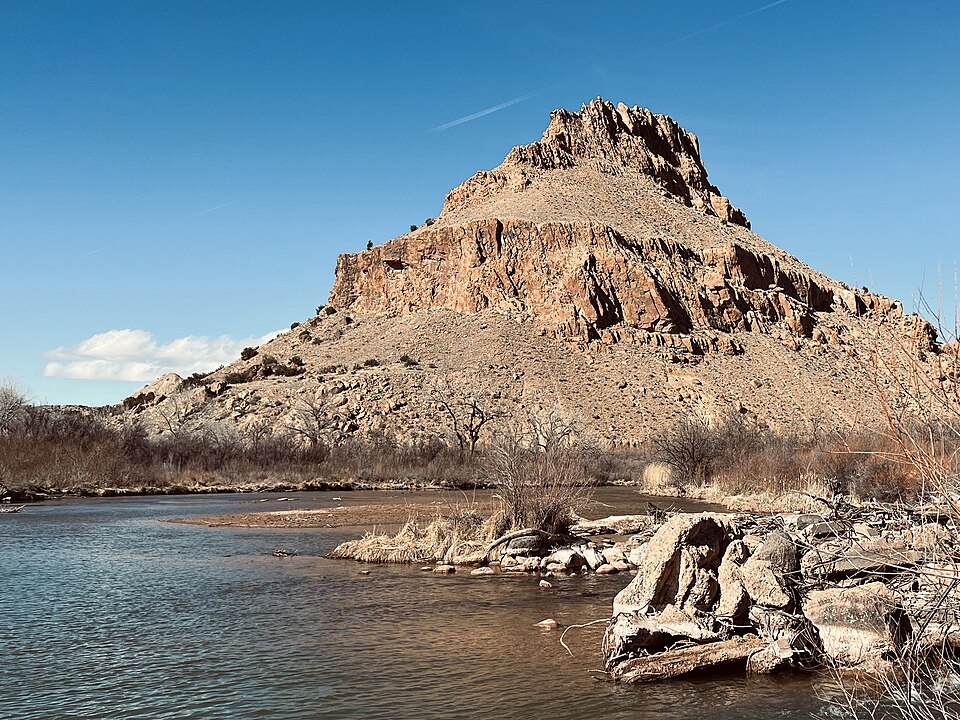
Ohkay Owingeh is a living Tewa-speaking community. This bounded path examines community housing and preservation through a hosted reported feature and an outside federal case study. The Rio Chama image shows an upstream regional waterway, not the Pueblo or an exact confluence.
See each region’s evidence for historical or present-day scope.
Homeland / region
Southwest / New Mexico
Research depth
Source guide
Source collection
4 annotated resources · 2 Indigenous-led
Inspected sources
2 substantive works · selected content reviewed
Initial adequacy
Still unfinished
Source review
October 28, 2026
A source guide for a deeper dive.This entry provides a brief orientation and an organized reading path. A comprehensive deep dive has not yet been completed. Follow the annotated sources and distinguish primary community accounts from outside reference material.
Still unfinished
A bounded actual-content starting path and specifically scoped credited picture are available. Fuller history, source comparison and community review remain open; quantity does not establish completion.
Assessment recorded October 28, 2026. This is separate from research completion and community review.
Develop broader community-authored history and substantive public Tewa educational sources beyond the preservation-project focus.
Read underlying agreements and later public project reports before claiming current outcomes.
The direct community-site certificate has expired; no bypass was used. The river photograph is upstream near Abiquiú, not the village, exact confluence or reservation land.
Backdrop photographs & credits
These photographs have individual, documented connections to this entry. Their captions and source records define the people, place, object, and period shown; no one photograph represents every community within a broader label.
Rio Chama near Abiquiú — upstream regional context, 2023 Matt Walter / Flickr photograph via Wikimedia Commons · CC BY 2.0
The photographer explicitly identifies the Rio Chama in/around Abiquiú. Ohkay’s own public introduction names the Rio Chama/Rio Grande confluence. This is an upstream regional waterway view, NOT the Pueblo, exact confluence, a former village, current reservation land or access permission. No relationship to another community is inferred from proximity. Complete available retrieved JPEG imported unchanged. Background/card CSS crops and overlays affect presentation; the opened page retains the complete available frame proportionally.
Image, association, and reuse record reviewed 2026-10-28.
Full photographs are displayed proportionally above. A translucent background copy may be cropped by the viewport; it does not replace the complete image or its record.
The visual treatment does not change the research status, evidence, or remaining gaps recorded in this profile.
Start reading here
A short purposeful path through selected actual-content works. Read annotations for community, period and inspection limits; this is not a complete history or community endorsement.
Compare the federal case study’s explanation of documentation, consultation and housing work.
These are selected starting points. The full annotated collection, source perspectives, inspection limits and remaining research questions follow below. A starting guide is not an exhaustive history or community endorsement.
01
Identity and context
Ohkay Owingeh is a living Pueblo nation whose preferred name replaces the older San Juan Pueblo label in many sources.
Focus the next stage of research on: Pueblo-authored history, Tewa language and contemporary community life. The sources below are selected reading paths; their authorship, dates and community scope should guide how they are used.
The community-hosted feature reports residents, housing staff and architects working together to retain housing while adding contemporary amenities. Its interviews and project narrative are attributed accounts, with a Winter 2015 layout marker. They should not be read as a current census of renovated homes or a complete community history.
The federal case study describes youth documentation, consultation and a housing-authority project balancing preservation with contemporary living. Read it alongside the hosted feature, keeping process descriptions separate from uninspected agreements and later outcomes. The Pueblo’s own introduction supplies the river connection; an upstream Abiquiú view does not establish Pueblo boundaries or access.
Develop broader community-authored history and substantive public Tewa educational sources beyond the preservation-project focus.
Read underlying agreements and later public project reports before claiming current outcomes.
The direct community-site certificate has expired; no bypass was used. The river photograph is upstream near Abiquiú, not the village, exact confluence or reservation land.
Cohort13: selected actual-content reviews preserve their institutional/community scope. Existing source cards are upgraded at the same ID and URL where noted; repeated publications are not globally new works.
Follow the reading path
Sources & further reading
Open any title to read the original source. Annotations explain what each link can help you explore.
No Indigenous-led source is identified in this entry yet. This is a gap in this collection, and does not imply an absence of community knowledge or organization.
Indigenous-ledPueblo of Ohkay Owingeh; hosts reported preservation featureSource 1
The hosted feature describes community-led housing preservation through reported interviews with residents, housing staff and architects. It is a retrospective project account, not a complete Pueblo history.
Inspection: Content reviewed for the stated scope
Scope: Actual substantial indexed article body: selected housing-authority/architect partnership, youth documentation, resident/advisory participation, and traditional materials/modern amenities discussion. Winter 2015 layout marker encountered; original byline not established.
Review recorded: October 28, 2026
Access note: Direct normal HTTPS retrieval failed expired-certificate validation and ordinary reader retrieval timed out; substantial indexed body was available and read. No bypass, full original magazine/PDF or underlying interviews reviewed. Sacred descriptions, family property details, original photos, precise site coordinates and numerical outcomes excluded. Interview statements remain attributed. No outreach or access bypass. Linked media, original records and additional collections were not automatically inspected or licensed.
Historical context for this entry. Read “Historical and cultural reference for Ohkay Owingeh” with attention to the author, period covered, and communities named; compare with community-published accounts where available.
The federal case study explains youth documentation, intergovernmental consultation and the housing authority’s effort to combine preservation with contemporary living. It supplies an outside project interpretation to compare with the hosted feature.
Inspection: Content reviewed for the stated scope
Scope: Actual case-study main body: selected Story naming bridge; Project, process and construction/consultation explanations; consulting-parties list. Private traditional knowledge and ritual detail excluded.
Review recorded: October 28, 2026
Access note: Normal HTTP200 and ordinary web reader. No original agreement, underlying surveys, private records or current-law determination. Retrospective Now wording, family/funding/job totals and awards are not used as current outcomes. Project process is the institution’s account. No outreach or access bypass. Linked media, original records and additional collections were not automatically inspected or licensed.
The Pueblo’s short public introduction identifies Ohkay Owingeh as a Tewa-speaking community at the Rio Grande and Chama rivers. This supports the named-waterway image context, not another substantive history count.
Inspection: Supporting or limited review; see scope
Scope: Actual indexed Our History and public community-introduction paragraphs, specifically Tewa and Rio Grande/Rio Chama confluence wording.
Review recorded: October 28, 2026
Access note: Direct domain HTTPS has an expired certificate; actual indexed body was read without bypass. Brief home introduction excluded from substantive counts. No precise petroglyph/archaeological locations, present officials or visitor-event schedules adopted. No outreach or access bypass. Linked media, original records and additional collections were not automatically inspected or licensed.
Related entries may represent alternate names, constituent communities, wider groupings, or historical connections. Read the naming notes before treating entries as equivalent.
Robey’s Atlas of Indigenous North America · Compiled October 19, 2026 · Ohkay Owingeh