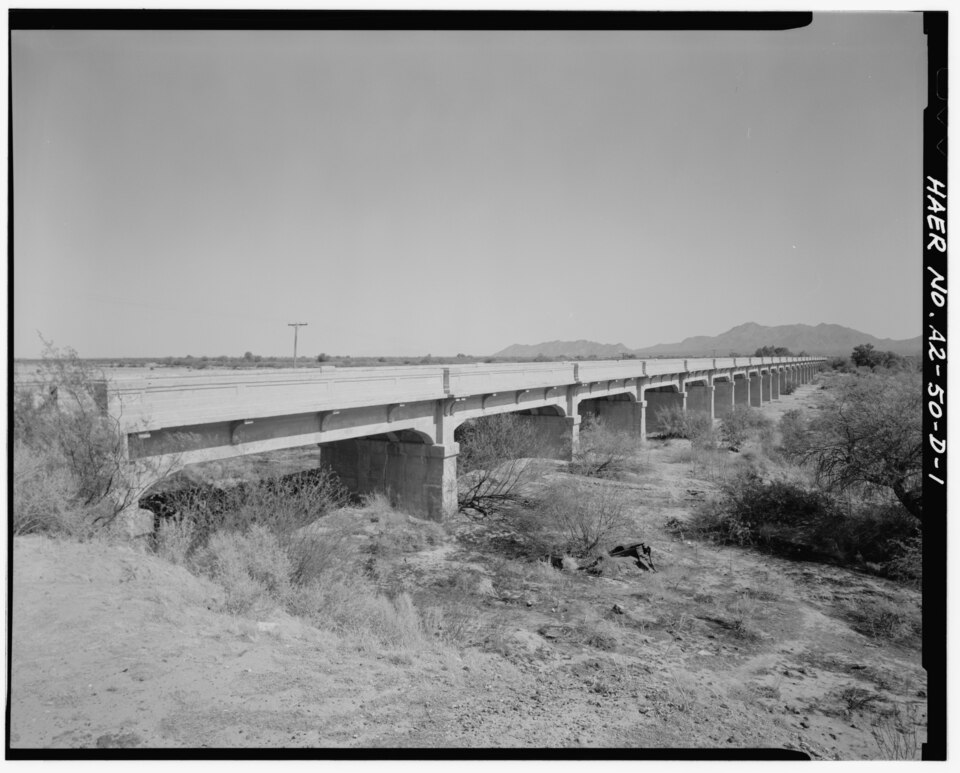
Sacaton Dam and Bridge, downstream side from north end, 1995Bob Knotts / Library of Congress, Prints and Photographs Division; Historic American Engineering Record, AZ-50-D / ARIZ, 11-COOL, 1D-1, via Wikimedia Commons · Public domain — item-specific Commons PD-USGov-NPS designation
Akimel O’odham, often encountered under the historical reading label Pima, should not be reduced to one present government. Salt River Pima-Maricopa Indian Community and Gila River Indian Community publish distinct accounts of their O’odham and Piipaash/Pee Posh communities. Together with an irrigation education lesson, they provide starting points for farming, water loss and community history.
See each region’s evidence for historical or present-day scope.
Homeland / region
Southwest / Arizona
Research depth
Source guide
Source collection
4 annotated resources · 4 Indigenous-led
Inspected sources
3 substantive works · selected content reviewed
Initial adequacy
Still unfinished
Source review
October 28, 2026
A source guide for a deeper dive.This entry provides a brief orientation and an organized reading path. A comprehensive deep dive has not yet been completed. Follow the annotated sources and distinguish primary community accounts from outside reference material.
Still unfinished
A bounded actual-content starting path and specifically scoped credited picture are available. Fuller history, source comparison and community review remain open; quantity does not establish completion.
Assessment recorded October 28, 2026. This is separate from research completion and community review.
Still unfinished: additional Akimel O’odham-authored history, original water records and dated contemporary accounts remain useful.
The Salt River timeline duplicates a component of its main history and is not another counted work.
The Sacaton image depicts modern federal irrigation infrastructure and a dry channel, not traditional architecture or evidence of restored water.
Backdrop photographs & credits
These photographs have individual, documented connections to this entry. Their captions and source records define the people, place, object, and period shown; no one photograph represents every community within a broader label.
Sacaton Dam and Bridge, downstream side from north end, 1995 Bob Knotts / Library of Congress, Prints and Photographs Division; Historic American Engineering Record, AZ-50-D / ARIZ, 11-COOL, 1D-1, via Wikimedia Commons · Public domain — item-specific Commons PD-USGov-NPS designation
Modern San Carlos Irrigation Project infrastructure at the Gila River/Sacaton Dam and Bridge, specifically identified by the HAER record. Community publications document the Gila River farming and water-history connection. Not traditional Akimel O’odham architecture, a portrait of all Pima communities, evidence of restored flow or a legal/territorial claim. Complete available retrieved JPEG imported unchanged. Background/card CSS crops and overlays affect presentation; the opened page retains the complete available frame proportionally.
Image, association, and reuse record reviewed 2026-10-28.
Full photographs are displayed proportionally above. A translucent background copy may be cropped by the viewport; it does not replace the complete image or its record.
The visual treatment does not change the research status, evidence, or remaining gaps recorded in this profile.
Start reading here
A short purposeful path through selected actual-content works. Read annotations for community, period and inspection limits; this is not a complete history or community endorsement.
Compare the distinct Gila River community’s own history.
These are selected starting points. The full annotated collection, source perspectives, inspection limits and remaining research questions follow below. A starting guide is not an exhaustive history or community endorsement.
01
Identity and context
Akimel O’odham is a people’s name encountered alongside Pima. The Gila River Indian Community includes distinct constituent peoples.
Focus the next stage of research on: River relationships, language and community-specific history. The sources below are selected reading paths; their authorship, dates and community scope should guide how they are used.
Read particular communities within a broader label
The Salt River and Gila River accounts each identify distinct O’odham and Piipaash/Pee Posh peoples within a particular community. Their histories are related reading routes, not interchangeable government names or evidence that all these peoples are one group. Keep the speaker and community scope attached to each account.
The community histories and irrigation lesson connect farming with river water and describe the consequences of diversion. The lesson is especially useful for an introductory account of water loss, but its future-looking project language belongs to the document’s own period. It does not establish that later irrigation plans were completed or resolve present legal rights.
The education lesson distinguishes archaeological interpretations from community histories and asks readers to consider where interpretations differ. Labels such as Hohokam should therefore be read within their scholarly and community contexts, not used as proof that a people vanished or as an automatic identity assignment. The underlying archaeological works require separate inspection.
Still unfinished: additional Akimel O’odham-authored history, original water records and dated contemporary accounts remain useful.
The Salt River timeline duplicates a component of its main history and is not another counted work.
The Sacaton image depicts modern federal irrigation infrastructure and a dry channel, not traditional architecture or evidence of restored water.
Cohort13: selected actual-content reviews preserve their institutional/community scope. Existing source cards are upgraded at the same ID and URL where noted; repeated publications are not globally new works.
Follow the reading path
Sources & further reading
Open any title to read the original source. Annotations explain what each link can help you explore.
No Indigenous-led source is identified in this entry yet. This is a gap in this collection, and does not imply an absence of community knowledge or organization.
Indigenous-ledSalt River Pima-Maricopa Indian CommunitySource 1
A Salt River Pima-Maricopa Indian Community history introduces its distinct O’odham and Piipaash peoples, farming and the consequences of river diversion. It is one government/community perspective within a wider Akimel O’odham reading route.
Inspection: Content reviewed for the stated scope
Scope: Actual main History body, ordinary web-reader lines 49–71: two distinct peoples, community history, archaeology/ancestry interpretation, irrigation and diversion. The timeline included farther down the page overlaps p293-s2 and is not counted again.
Review recorded: October 28, 2026
Access note: Actual selected public content inspected on 2026-10-28. No access bypass or outreach. Linked media are not cleared by this textual review. Normal HTTP 200 redirected www to non-www; inherited ID and original URL retained. Archaeological labels are not treated as vanished ethnic groups or automatic proof of a single descent line. Present legal boundaries, totals and current project outcomes are not established.
A timeline presented separately and also included within the Community History page. Retained as a navigation aid, excluded as a duplicate component of the same inspected community history.
Inspection: Supporting or limited review; see scope
Scope: Actual timeline body read and compared with the timeline embedded in p293-s1. Shared sequence and entries establish component duplication, not another independent historical work.
Review recorded: October 28, 2026
Access note: Actual selected public content inspected on 2026-10-28. No access bypass or outreach. Linked media are not cleared by this textual review. Same ID/URL preserved. Supporting duplicate only; no additional substantive source count.
A Pima-Maricopa Irrigation Project education lesson introduces Akimel O’otham and Pee Posh histories and water loss. Read its historical overview and its distinction between archaeological interpretations and community memory.
Inspection: Content reviewed for the stated scope
Scope: Actual extracted text of all four PDF pages inspected. Selected use: p.1 opening identifies two distinct peoples; p.2 farming/water-loss narrative; p.3 educational objectives and the explicit limits of archaeological agreement. The p.4 chart was text-extracted, not visually rendered.
Review recorded: October 28, 2026
Access note: Actual selected public content inspected on 2026-10-28. No access bypass or outreach. Linked media are not cleared by this textual review. Four-page PDF normally retrieved HTTP 200. Undated legacy lesson includes future-looking irrigation/settlement language; no project completion or current acreage is asserted. Underlying quotations and archaeological publications were not inspected. No full visual chart inspection claimed.
The Community’s historical account connects its Akimel O’otham and Pee Posh peoples with farming, irrigation and the effects of river diversion. It complements rather than replaces the separate Salt River account.
Inspection: Content reviewed for the stated scope
Scope: Actual substantial main History body: community self-description, irrigation/agriculture, selected colonial-observer narrative and water loss. Conflicting/qualified arrival chronology and future-looking irrigation plans were read but not adopted as settled/current facts.
Review recorded: October 28, 2026
Access note: Actual selected public content inspected on 2026-10-28. No access bypass or outreach. Linked media are not cleared by this textual review. This is a particular community perspective, not all Pima-speaking people or proof that Pee Posh are the same people. Original colonial texts were not inspected. Future-looking project language is treated as legacy; no current irrigation outcome, legal entitlement or boundary is inferred.
Related entries may represent alternate names, constituent communities, wider groupings, or historical connections. Read the naming notes before treating entries as equivalent.
Robey’s Atlas of Indigenous North America · Compiled October 19, 2026 · Pima (Akimel O'odham)