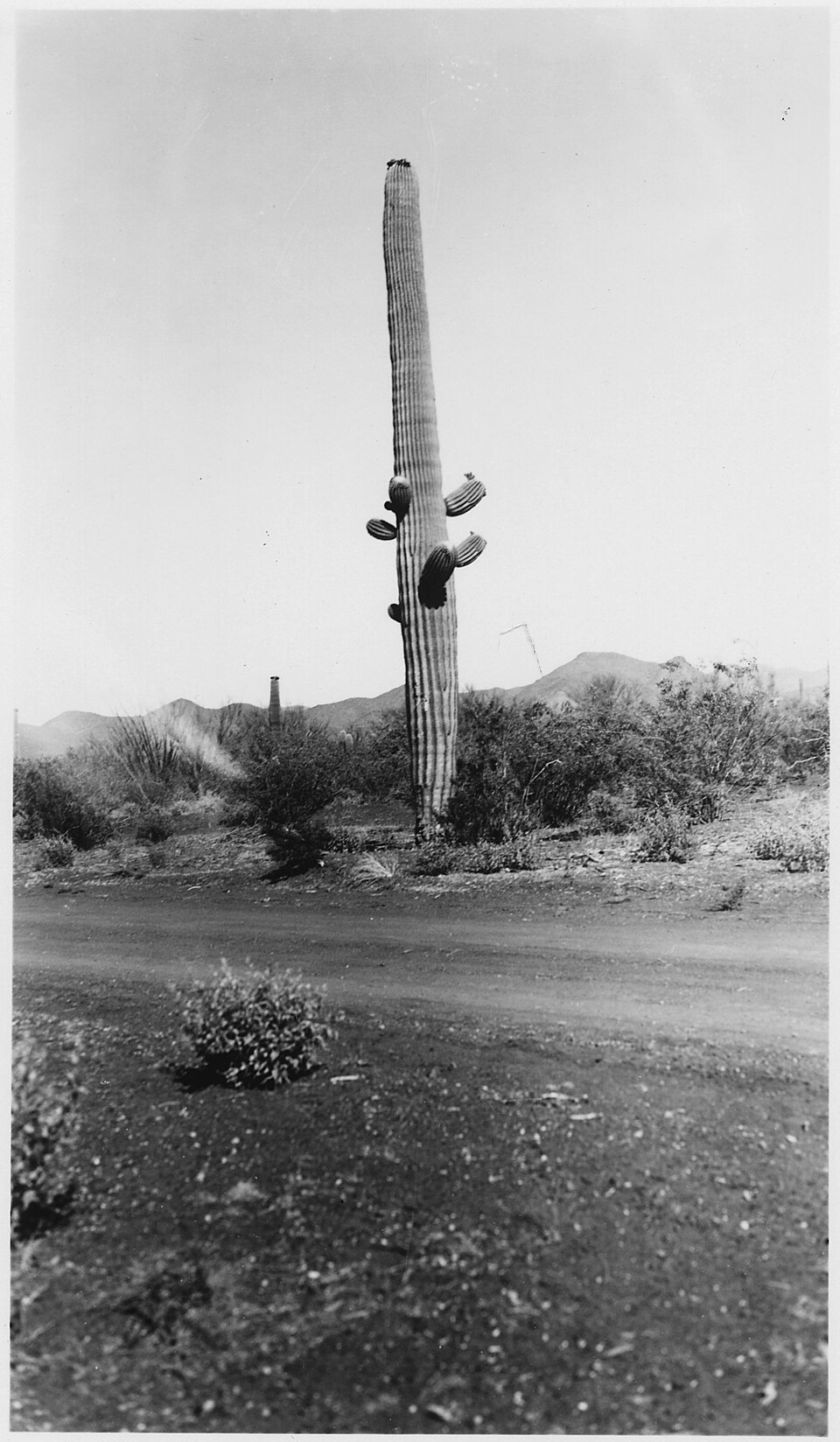
Saguaro cactus at Sells — archival landscape, photograph date not statedPhotographer not identified in archive record / National Archives and Records Administration, NAID 295244; Record Group 75, Publicity Photographs; Bureau of Indian Affairs, Phoenix Area Office, Papago Agency (historical record wording) · Public domain — item-specific U.S. government work designation; Public Domain Mark 1.0
The Tohono O’odham Nation’s public account connects its history with the Sonoran Desert and communities divided by an international border. Tohono O’odham Community College adds a different institutional perspective on local higher education and community-guided learning. Related O’odham communities and governments retain their own histories.
See each region’s evidence for historical or present-day scope.
Homeland / region
Southwest / Arizona / Mexico
Research depth
Source guide
Source collection
4 annotated resources · 4 Indigenous-led
Inspected sources
3 substantive works · selected content reviewed
Initial adequacy
Still unfinished
Source review
October 28, 2026
A source guide for a deeper dive.This entry provides a brief orientation and an organized reading path. A comprehensive deep dive has not yet been completed. Follow the annotated sources and distinguish primary community accounts from outside reference material.
Still unfinished
A bounded actual-content starting path and specifically scoped credited picture are available. Fuller history, source comparison and community review remain open; quantity does not establish completion.
Assessment recorded October 28, 2026. This is separate from research completion and community review.
Still unfinished: fuller community-authored histories and original educational records remain useful.
The inherited History route is empty and is not a counted work.
The archival saguaro image has no stated photograph date or named photographer; agency-period metadata is not treated as the photograph date.
Backdrop photographs & credits
These photographs have individual, documented connections to this entry. Their captions and source records define the people, place, object, and period shown; no one photograph represents every community within a broader label.
Saguaro cactus at Sells — archival landscape, photograph date not stated Photographer not identified in archive record / National Archives and Records Administration, NAID 295244; Record Group 75, Publicity Photographs; Bureau of Indian Affairs, Phoenix Area Office, Papago Agency (historical record wording) · Public domain — item-specific U.S. government work designation; Public Domain Mark 1.0
Historical archive identifies a saguaro landscape at Sells using the period title “Sells Indian Reservation.” Read beside the Nation’s Sonoran Desert account. Not a ceremonial harvest, current land boundary, permission to visit/photograph, or generic substitute for all O’odham communities. The archive’s 1950 agency metadata is not assigned as the photograph date. Complete available retrieved JPEG imported unchanged. Background/card CSS crops and overlays affect presentation; the opened page retains the complete available frame proportionally.
Image, association, and reuse record reviewed 2026-10-28.
Full photographs are displayed proportionally above. A translucent background copy may be cropped by the viewport; it does not replace the complete image or its record.
The visual treatment does not change the research status, evidence, or remaining gaps recorded in this profile.
Start reading here
A short purposeful path through selected actual-content works. Read annotations for community, period and inspection limits; this is not a complete history or community endorsement.
Read the college’s public explanation of its educational approach.
These are selected starting points. The full annotated collection, source perspectives, inspection limits and remaining research questions follow below. A starting guide is not an exhaustive history or community endorsement.
01
Identity and context
Tohono O’odham people have homelands across the modern U.S.–Mexico border.
Focus the next stage of research on: Language, desert relationships and distinct political communities and governments. The sources below are selected reading paths; their authorship, dates and community scope should guide how they are used.
The Nation’s public history describes farming and seasonal adaptation in the Sonoran Desert and explains how nineteenth-century border making divided communities. This is historical context, not guidance about present border-crossing documents, citizenship or individual legal rights. Related O’odham governments should not be treated as aliases for the Nation.
TOCC describes community leaders’ efforts toward a local college, a charter from the Nation in 1998 and classes beginning in 2000 through Pima Community College. Its later institutional timeline provides further reading. These are the college’s reported historical milestones; current accreditation and enrolment arrangements need their own checks.
The college’s public Himdag account describes a committee involving community members, students, faculty and staff and explains how language and cultural learning inform its educational work. This introduces one institution’s approach without reproducing restricted knowledge or claiming that every O’odham person shares an identical interpretation.
Still unfinished: fuller community-authored histories and original educational records remain useful.
The inherited History route is empty and is not a counted work.
The archival saguaro image has no stated photograph date or named photographer; agency-period metadata is not treated as the photograph date.
Cohort13: selected actual-content reviews preserve their institutional/community scope. Existing source cards are upgraded at the same ID and URL where noted; repeated publications are not globally new works.
Follow the reading path
Sources & further reading
Open any title to read the original source. Annotations explain what each link can help you explore.
No Indigenous-led source is identified in this entry yet. This is a gap in this collection, and does not imply an absence of community knowledge or organization.
An inherited History link currently yields a heading, post date and site navigation without a substantive historical body. Retained as an excluded route rather than a reviewed history.
Inspection: Supporting or limited review; see scope
Scope: Actual normally retrieved page inspected: History heading, September 19, 2016 post date, navigation/footer and no substantive historical paragraphs.
Review recorded: October 28, 2026
Access note: Actual selected public content inspected on 2026-10-28. No access bypass or outreach. Linked media are not cleared by this textual review. An actual page inspection, not a substantive historical work. The empty route is excluded; the separate History & Culture page supplies the body content.
The Nation’s public history and culture account introduces a Sonoran Desert homeland, farming and the effects of an international border. It is a Nation-published perspective, not every related O’odham government’s history.
Inspection: Content reviewed for the stated scope
Scope: Actual main body, ordinary web-reader lines 76–94: Sonoran setting, farming/seasonal adaptation, attributed ancestry interpretation and the historical border-division narrative.
Review recorded: October 28, 2026
Access note: Actual selected public content inspected on 2026-10-28. No access bypass or outreach. Linked media are not cleared by this textual review. Present passport/border-crossing rules, citizenship, membership totals and all-group legal status are not adopted. Archaeological ancestry claims remain attributed interpretations. No sacred narrative, ceremony or restricted knowledge reproduced.
The college’s history describes community efforts toward a local institution, the Nation’s 1998 charter and classes beginning in 2000, followed by institutional milestones.
Inspection: Content reviewed for the stated scope
Scope: Actual public History body, ordinary web-reader lines 173–219: community leaders’ efforts, 1998 charter, 2000 classes through Pima Community College and reported 2005 accreditation; selected institutional timeline.
Review recorded: October 28, 2026
Access note: Actual selected public content inspected on 2026-10-28. No access bypass or outreach. Linked media are not cleared by this textual review. Institutional self-history. Underlying charter and accreditation records were not inspected; no current accreditation, officeholder, enrolment or service-availability claim is made.
The college explains how a community/faculty/student committee and language/cultural learning inform its public educational approach. Read this as an institutional account of teaching.
Inspection: Content reviewed for the stated scope
Scope: Actual public main body, ordinary web-reader lines 175–207: college educational approach, Himdag committee and language/cultural curriculum. Public values were encountered but no restricted knowledge, songs or ceremonial instruction was copied.
Review recorded: October 28, 2026
Access note: Actual selected public content inspected on 2026-10-28. No access bypass or outreach. Linked media are not cleared by this textual review. No assertion that one institution speaks for every O’odham person. Graduation requirements and current enrolment advice are not supplied. Linked lessons, recordings and underlying curricula were not inspected.
Related entries may represent alternate names, constituent communities, wider groupings, or historical connections. Read the naming notes before treating entries as equivalent.
Robey’s Atlas of Indigenous North America · Compiled October 19, 2026 · Tohono O'odham