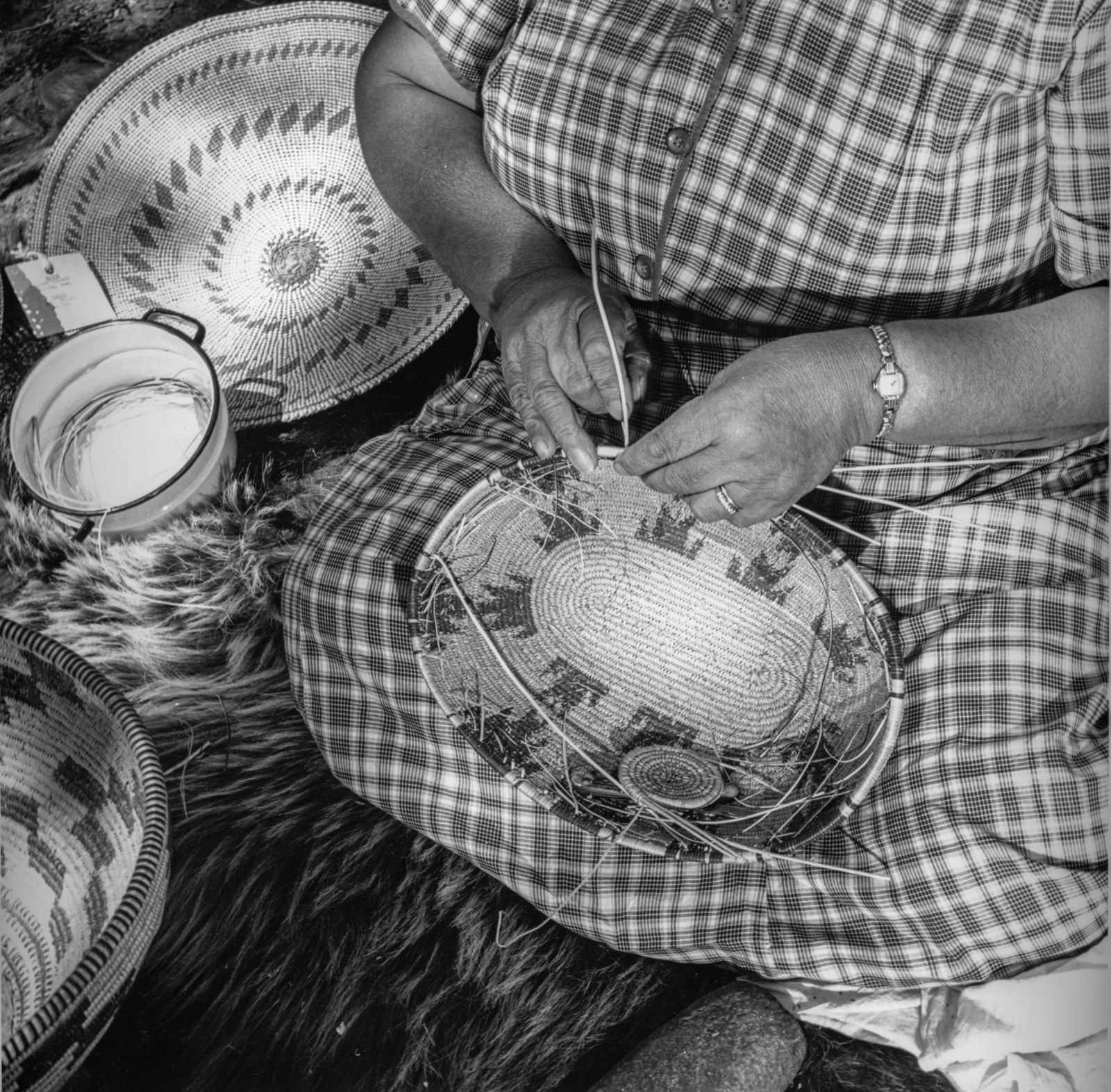
Selena LaMarr practicing Atsugewi basketryNational Park Service, Lassen Volcanic National Park; Hat Creek Atsugewi Historic Photograph Collection. The gallery credit field names Selena LaMarr; this is not treated as evidence that she photographed herself.
Collective tribal government of eleven autonomous bands · Added to the original list
Pit River Tribe
Also find this entry through: Pit River Tribe (Ajumawi–Atsugewi Nation)
The Pit River Tribe is a living collective government of eleven autonomous bands in northeastern California. This starting guide distinguishes the government, individual band routes and broader Achumawi and Atsugewi reading labels. Its selected sources connect band authority with contemporary language, environmental and community work; the collection remains unfinished.
See each region’s evidence for historical or present-day scope.
Homeland / region
Northeastern California / collective tribal-government context
Research depth
Source guide
Source collection
5 annotated resources · 3 Indigenous-led
Inspected sources
5 substantive works · selected content reviewed
Initial adequacy
Still unfinished
Source review
October 31, 2026
Names & relationshipsA named collective government, not another band or a synonym replacing the broader Achumawi and Atsugewi reading routes. Its posted constitution and homepage name eleven constituent bands; individual bands and historical regional/language groupings retain separate scopes.
A source guide for a deeper dive.This entry provides a brief orientation and an organized reading path. A comprehensive deep dive has not yet been completed. Follow the annotated sources and distinguish primary community accounts from outside reference material.
Still unfinished
A scoped selected-content introduction with credited imagery. Further community-authored depth, primary historical context and community review remain gaps.
Assessment recorded October 30, 2026. This is separate from research completion and community review.
Backdrop photographs & credits
These photographs have individual, documented connections to this entry. Their captions and source records define the people, place, object, and period shown; no one photograph represents every community within a broader label.
Selena LaMarr practicing Atsugewi basketry National Park Service, Lassen Volcanic National Park; Hat Creek Atsugewi Historic Photograph Collection. The gallery credit field names Selena LaMarr; this is not treated as evidence that she photographed herself.
Actual NPS people-page body read and complete album API read. Exact asset explicitly identifies Selena LaMarr and Hat Creek Atsugewi basketry and carries item-specific public-domain designation. Downloaded the official original JPEG unchanged and visually inspected complete available frame. It is already a close-up excluding her face; this is the archive-delivered composition, not a crop made here. No ceremony or restricted designation identified. Neither the design nor the one demonstrator is claimed to represent all Atsugewi cultural life. API PhotoCredit repeats the subject name; individual photographer remains unrecorded. Delivery copies are proportionally resized/recompressed from the complete archive-delivered frame. Card and page-background CSS may crop or overlay; the page banner preserves the full composition. This visual review does not increase substantive source counts or establish research completion. Scoped reuse for this reading route: one historical Hat Creek Atsugewi example, not a determination of Selena LaMarr’s modern band-roll membership, a government portrait, every constituent band or a modern boundary. Existing source-frame and delivery derivatives remain unchanged. Root viewed the full available delivery composition again; original item-specific NPS API clearance is retained from its cached record, not claimed freshly retrieved today.
Image, association, and reuse record reviewed 2026-10-30.
Full photographs are displayed proportionally above. A translucent background copy may be cropped by the viewport; it does not replace the complete image or its record.
The visual treatment does not change the research status, evidence, or remaining gaps recorded in this profile.
Start reading here
Useful supplementary guide; not a completed twenty-profile cohort or exhaustive history.
Read this selected account with its recorded authorship, period, perspective and access limits.
These are selected starting points. The full annotated collection, source perspectives, inspection limits and remaining research questions follow below. A starting guide is not an exhaustive history or community endorsement.
01
Eleven bands within a collective government
The Tribe’s published constitution names Ajumawi, Atsugewi, Atwamsini, Ilmawi, Astarawi, Hammawi, Hewisedawi, Itsatawi, Aporige, Kosalektawi and Madesi. Its posted text recalls the 1964 constitution and is marked updated July 2005. It provides collective representation while recognizing band cultural responsibilities. The eleven band routes below make those names separately findable; they do not imply eleven separately verified federal recognitions or identical community histories.
Environmental responsibilities and community learning
The Environmental Programs Office describes water monitoring, ecological restoration, youth science education, gardens and a native-plant greenhouse among its responsibilities. The Tribe’s November 2025 newsletter reports greenhouse renewal and a language camp held at Lassen on August 30. These are collective institutional descriptions and dated event reports. They do not assign every activity or participant to one band, establish present fluency, or demonstrate completed ecological outcomes.
Shared government does not make one band’s account interchangeable with another’s. The constitutional text recognizes individual band responsibilities for cultural matters. This directory therefore links specific band routes with visible identification references and records remaining source and image gaps. The historical photograph shown here is a Hat Creek Atsugewi example; it is not a portrait of the tribal government or a visual substitute for all eleven bands.
A September 2026 Senate committee report places the proposed Four Corners transfer within a longer history of Pit River land loss and political organizing. It connects the 1970 occupation near Burney with the Tribe’s later effort to acquire that property. The report draws on testimony and published history; those underlying works require their own review. This is a collective Pit River account, rather than an Atsugewi-only chronology or a court determination of present land title.
Following a legislative step without assuming the outcome
The committee report recommends an amended bill. A separate Senate text dated September 30, 2026 records passage with an amendment and sets out transfer, trust and survey provisions for Four Corners. Reading the two documents together distinguishes a legislative proposal from its historical justification. This dated bill version alone does not establish later enactment, a completed conveyance or present ownership; those questions need later official records.
A government-specific starting guide may reuse prior reviewed constitutional/newsletter contexts only with their original dates and scopes, not as globally new works.
Existing selected reviews are transferred with original dates/scopes; a short route is not a full reading of every underlying work. No present census, band-roll equivalence or community endorsement.
Dated2026committee and Senate-version documents are not current enactment,conveyance or title findings. Underlying cited works remain separately uninspected.
Follow the reading path
Sources & further reading
Open any title to read the original source. Annotations explain what each link can help you explore.
No Indigenous-led source is identified in this entry yet. This is a gap in this collection, and does not imply an absence of community knowledge or organization.
Publication: 1964 adoption; published text updated July 2005
Read the preamble and Articles I–II, VI and VII, including band powers. The Tribe publishes this text as adopted in 1964 and updated July 2005. It distinguishes the eleven-band political entity from language labels and recognizes band cultural authority. No complete 2026 legal consolidation, title survey or independent jurisdictional ruling is inferred.
Inspection: Content reviewed for the stated scope
Scope: Read the preamble and Articles I–II, VI and VII, including band powers. The Tribe publishes this text as adopted in 1964 and updated July 2005. It distinguishes the eleven-band political entity from language labels and recognizes band cultural authority. No complete 2026 legal consolidation, title survey or independent jurisdictional ruling is inferred.
The Tribe describes water monitoring, ecological restoration, youth science education, a native-plant greenhouse and gardens as programme areas. It also lists dated quality-assurance milestones. The page describes collective institutional responsibilities, not measured outcomes or a separate Atsugewi department.
Inspection: Content reviewed for the stated scope
Scope: Complete substantive primary webpage body, mission, programme-area list and water-programme accomplishments, web-reader lines 7–37. Staff/contact details and images are not used as research evidence.
Review recorded: October 30, 2026
Access note: Undated page: the accomplishment list names 2012–2016 and uses “2012-present,” which is not an independently verified 2026 status claim. One normal terminal request 403; stopped, actual primary web-reader body read. No underlying monitoring datasets, quality-assurance plans, restoration assessment or plant-management instructions inspected.
Later tribal reporting follows the August 2025 language-camp invitation with an account of the camp held on August 30 at Lassen. Other selected reports concern greenhouse restoration and community planning. This is collective Pit River reporting; it does not establish an Atsugewi-only curriculum, present fluency or completed grant outcomes.
Inspection: Content reviewed for the stated scope
Scope: Actual six-page PDF text supplied by the primary web reader: PDF p.1 Four Corners commemoration report; p.3 language-camp report and class invitation; p.4 greenhouse-restoration/funding report; p.6 community-input and energy-survey summaries. Page headings and pagination checked in the actual PDF extraction. Not a full six-page close reading or image inspection.
Review recorded: October 30, 2026
Access note: One normal terminal request returned 403 and stopped; the primary-source web-reader body was accessible. No challenge bypass. Zoom credentials and class access details are not reproduced. Attendance estimates, grant sums, trust-title assertions, bill status, survey percentages and later outcomes are not adopted. A report of a camp is distinct from its earlier invitation; shared Pit River participation does not identify every participant’s band or language.
A dated committee account connects the proposed Four Corners transfer with earlier land loss and the 1970 occupation. Its historical synthesis cites testimony and scholarship, which are not thereby independently inspected. Read it as collective Pit River legislative context, not an Atsugewi-only chronology or a court finding.
Inspection: Content reviewed for the stated scope
Scope: Actual GovInfo HTML header/date, Purpose, selected Background and Need paragraphs, Summary and Legislative History: primary web-reader lines0–160. Particular close reading of land-loss discussion80–93 and Four Corners account113–132. Later executive testimony and the underlying cited books/hearings were not closely reviewed.
Review recorded: October 31, 2026
Access note: Exact normal terminal HTML retrieval returned200 and was saved privately. Report recommendation and proposed provisions do not establish current enactment, completed trust transfer, land ownership or programme outcomes. Current legislative status was not inspected in this bounded source packet; no present non-enactment claim is made. The report's rancheria/acreage/participant/arrest totals and its place-specific legal characterizations are not adopted.
The dated Senate resolution records passage with an amendment and supplies a replacement bill text. Selected transfer, trust and survey language explains what this version proposed. A bill version must be distinguished from an enacted public law, a completed conveyance and present title.
Inspection: Content reviewed for the stated scope
Scope: Actual GovInfo XHTML: dated resolution and short title, then Section2(a)–(c) and selected definitions(g), primary web-reader lines0–39. Complete offered HTML saved normally; this is a selected legislative-text reading, not inspection of the referenced June30,2026 map or a survey.
Review recorded: October 31, 2026
Access note: Exact normal terminal XHTML retrieval returned200 and was saved privately. No current enactment/non-enactment, trust conveyance, ownership or access finding is inferred. Referenced map, later actions, surveys and administrative transfer records were not inspected. No precise boundary, acreage/gaming advice or legal advice supplied.
These collections preserve links from supplied studies and further research leads. The collection notes explain their provenance and review status. Links already used above point to their source cards. Supporting references and unread leads are excluded from the substantive inspected-source count.
Atsugewi History Culture and Living Communities · 29 links
Owner-supplied study of historical Atsuge and Apwaruge contexts, broader Atsugewi language and people, and living Pit River communities. Historical regional labels and modern band identities remain distinct. These 29 URLs are contributed reading leads, not 29 verified works. Profile source annotations separately record actual selected-content reviews. Mirrors, descriptions, abstracts, announcements and unread leads are not automatically counted studies. The private full attachment is not reproduced.
Supplied bibliography note: [1] Pit River Tribe. Official home page. Current primary source for the eleven autonomous bands and the Tribe's description of its ancestral homeland. Website.
Supplied bibliography note: [2] Pit River Tribe. Constitution of the Pit River Tribe. Primary governing document. The preamble identifies the August 16, 1964 constitution; articles identify the bands, territory and institutions. Full PDF.
Supplied bibliography note: [22] Pit River Tribe. August 2025 Quarter 3 Newsletter. Primary community report concerning the Medicine Lake gathering, elections and contemporary tribal programs. Full PDF.
Supplied bibliography note: [23] Pit River Tribe. November 2025 Quarter 4 Newsletter. Primary source on the Four Corners commemoration, the 2025 language camp and community projects. Full PDF.
Supplied bibliography note: [24] Pit River Health Service. Pit River Language Zoom Session Dates. 2026. Primary program notice documenting language sessions. It does not give an Atsugewi fluency count. Full PDF.
Supplied bibliography note: [3] National Park Service. American Indian Heritage. Lassen Volcanic National Park. Institutional overview of seasonal land use, western and eastern Atsugewi identities and cultural teaching at the park. Web text.
Supplied bibliography note: [4] Kniffen, Fred B. Achomawi Geography. University of California Publications in American Archaeology and Ethnology 23, no. 5 (1928), 297–332. Especially pp. 315–320. Historical geographical scholarship based on local testimony, with material on Atsuge and Aporige settlements and exchange. Full scan.
Supplied bibliography note: [5] Garth, Thomas R. Atsugewi Ethnography. Anthropological Records 14, no. 2 (1953), 129–212. Major retrospective ethnography based on 1938–1939 fieldwork. Used here for source history, contributors and qualified historical claims. Full scan.
Supplied bibliography note: [6] Kroeber, A. L. Handbook of the Indians of California. Bureau of American Ethnology Bulletin 78. Washington, DC, 1925. Chapter 21, pp. 305–317, is relevant. Historical synthesis whose categories and generalizations need comparison with later research. Smithsonian record and public domain full text scan.
Supplied bibliography note: [6] Kroeber, A. L. Handbook of the Indians of California. Bureau of American Ethnology Bulletin 78. Washington, DC, 1925. Chapter 21, pp. 305–317, is relevant. Historical synthesis whose categories and generalizations need comparison with later research. Smithsonian record and public domain full text scan.
Supplied bibliography note: [7] Schulz, Paul E. Indians of Lassen Volcanic National Park and Vicinity. Loomis Museum Association, 1954. Historical interpretive synthesis with contributions from Selena LaMarr. Used for specific practices and objects, with its older judgments treated critically. Public domain full text.
Supplied bibliography note: [8] Dixon, Roland B. Achomawi and Atsugewi Tales. Journal of American Folklore 21, no. 81 (1908), 159–177. Especially the introduction and the Atsugewi narratives on pp. 170–177. Early mediated record of oral tradition, principally from Charley Snook for Atsugewi material. Public domain text and journal record.
Supplied bibliography note: [8] Dixon, Roland B. Achomawi and Atsugewi Tales. Journal of American Folklore 21, no. 81 (1908), 159–177. Especially the introduction and the Atsugewi narratives on pp. 170–177. Early mediated record of oral tradition, principally from Charley Snook for Atsugewi material. Public domain text and journal record.
Supplied bibliography note: [9] Smithsonian Institution, National Anthropological Archives. John Peabody Harrington Papers. Subseries 2.11, Achomawi Atsugewi Wintu Yana, 1922. Finding aid identifying contributors, subjects and archival holdings. This is an archival guide rather than a complete transcription of the field notes. Full PDF.
Supplied bibliography note: [10] University of California, Berkeley, California Language Archive. Atsugewi. Scholarly language overview and bibliography, including language area, classification and speaker status. Web text.
Supplied bibliography note: [11] Talmy, Leonard. Semantic Structures in English and Atsugewi. PhD dissertation, University of California, Berkeley, 1972. Introduction and acknowledgments. Primary linguistic research that explicitly credits Selina LaMarr and identifies fieldwork years. Introduction PDF.
Supplied bibliography note: [12] Talmy, Leonard. Borrowing Semantic Space Diachronic Hybridization. In Toward a Cognitive Semantics, volume 2. MIT Press, 2000, chapter 4. Especially the opening contrast between English and Atsugewi structures. Scholarly analysis hosted on the author's university site. Chapter PDF.
Supplied bibliography note: [25] Nevin, Bruce. Achumawi Database Summary of September 2021 Work. A specialist's working report explaining continuing questions about historical reconstruction and the need for Atsugewi morphological analysis. This is a research update, not a final consensus classification. Full PDF.
Supplied bibliography note: [13] Johnston-Dodds, Kimberly. Early California Laws and Policies Related to California Indians. California Research Bureau, September 2002. CRB-02-014. Historical research grounded in state laws, official records and contemporary accounts. Full report hosted by the California courts.
Supplied bibliography note: [14] Magliari, Michael F. Free State Slavery Bound Indian Labor and Slave Trafficking in California's Sacramento Valley 1850–1864. Pacific Historical Review 81, no. 2 (2012), 155–192. Peer reviewed historical study. The accessible abstract supports the regional economic point used here; full article access may require a subscription.
Supplied bibliography note: [15] Indian Claims Commission. The Pit River Indians of California v. United States. Docket 347, findings and opinion, July 29, 1959. 7 Indian Claims Commission 815–863. Primary legal record, including band identifications, Round Valley history and allotments. Full text through Oklahoma State University.
Supplied bibliography note: [18] United States Senate Committee on Indian Affairs. Pit River Land Transfer Act of 2026. Senate Report 119-147, September 22, 2026. Primary legislative report with historical background on land loss, the 1970 occupation and the proposed Four Corners transfer. Full text.
Supplied bibliography note: [19] United States Congress. H.R. 2400, Senate amendment, September 30, 2026. Primary text documenting Senate passage with an amendment. It is a bill version, not evidence by itself of enactment or completed transfer. Full text.
Supplied bibliography note: [26] Yale University Press. An American Genocide The United States and the California Indian Catastrophe 1846–1873, by Benjamin Madley. Publisher's description of the scholarly book first published in 2016. Used only to identify the book's statewide interpretive framework, rather than as access to the complete book.
Supplied bibliography note: [16] National Park Service. Selena LaMarr. Biographical account documenting her park work from 1952 to 1972 and Dessie Snooks's participation. Web text.
Supplied bibliography note: [17] Chapman, Emma. Lilian Snooks. National Park Service. Biographical account of Lillian Bernice Snooks, Sherman Institute and her cultural preservation work with relatives. The page title uses Lilian; the body uses Lillian. Web text.
Supplied bibliography note: [20] President of the United States. Proclamation 10882 Establishment of the Sáttítla Highlands National Monument. January 14, 2025. Primary proclamation recognizing cultural relationships, archaeological evidence and a federal management framework. Full text.
Supplied bibliography note: [21] Stanford Report. Charting the Journey of Sacred Sáttítla to National Monument Status. September 10, 2025. University account of the Environmental Law Clinic's involvement in the Pit River protection campaign. Web text.
Supplied bibliography note: Olmsted, D. L. A Lexicon of Atsugewi. Survey of California and Other Indian Languages, University of California, Berkeley, 1984. The Berkeley language overview identifies this as a major reference. The link opens the scanned lexicon; it is provided for further language study rather than as the basis for the historical conclusions above.
Related entries may represent alternate names, constituent communities, wider groupings, or historical connections. Read the naming notes before treating entries as equivalent.
Robey’s Atlas of Indigenous North America · Compiled October 19, 2026 · Pit River Tribe