Pojoaque is a distinct Tewa Pueblo in northern New Mexico. Its language department and tribally operated Poeh Cultural Center offer starting points into community-led teaching, art and cultural preservation.
See each region’s evidence for historical or present-day scope.
Homeland / region
Southwest / New Mexico
Research depth
Source guide
Source collection
4 annotated resources · 3 Indigenous-led
Inspected sources
2 substantive works · selected content reviewed
Initial adequacy
Still unfinished
Source review
October 28, 2026
A source guide for a deeper dive.This entry provides a brief orientation and an organized reading path. A comprehensive deep dive has not yet been completed. Follow the annotated sources and distinguish primary community accounts from outside reference material.
Still unfinished
A bounded actual-content starting path and specifically scoped credited picture are available. Fuller history, source comparison and community review remain open; quantity does not establish completion.
Assessment recorded October 28, 2026. This is separate from research completion and community review.
A useful institutional introduction, not a comprehensive history or community endorsement.
Underlying resolutions, original historical records and learning outcomes remain uninspected.
Individual artworks need separate rights review; the selected image shows a public institutional exterior.
Backdrop photographs & credits
These photographs have individual, documented connections to this entry. Their captions and source records define the people, place, object, and period shown; no one photograph represents every community within a broader label.
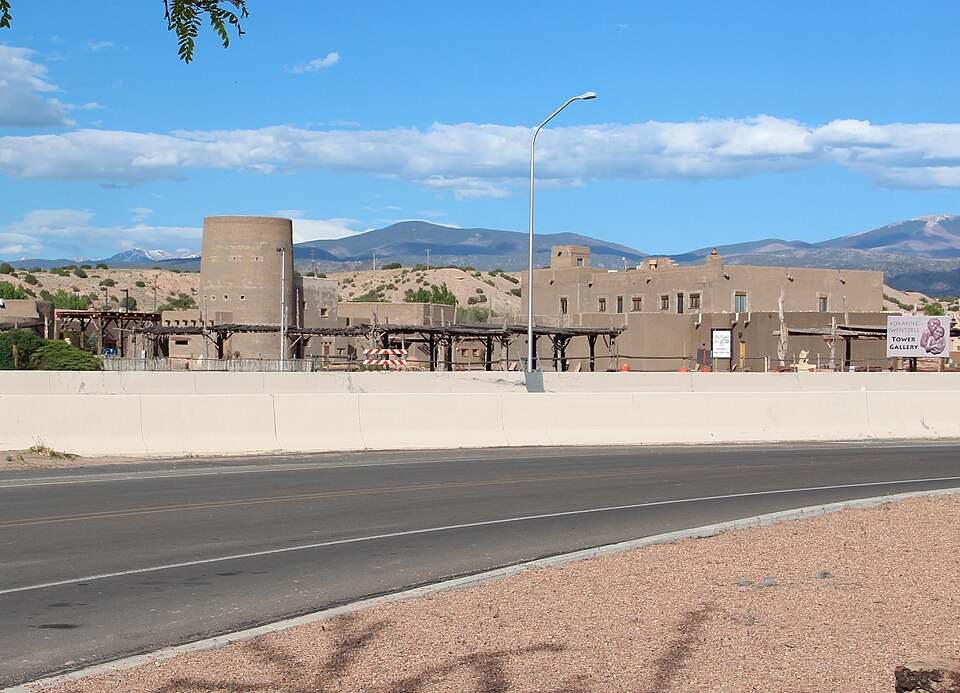
Poeh Cultural Center exterior, 10 May 2014 Thomson M / Panoramio, preserved by Wikimedia Commons · CC BY 3.0
Public cultural-center exterior viewed across a road, specifically connected to Pojoaque by its institutional history. Small Tower Gallery sign/art is incidental; no isolated artwork licence or permission for photography throughout the Pueblo asserted. Complete available retrieved JPEG imported unchanged. Background/card CSS crops and overlays affect presentation; the opened page retains the complete available frame proportionally.
Image, association, and reuse record reviewed 2026-10-28.
Full photographs are displayed proportionally above. A translucent background copy may be cropped by the viewport; it does not replace the complete image or its record.
The visual treatment does not change the research status, evidence, or remaining gaps recorded in this profile.
Start reading here
A short purposeful path through selected actual-content works. Read annotations for community, period and inspection limits; this is not a complete history or community endorsement.
Follow the cultural center’s institutional history and community-guided work.
These are selected starting points. The full annotated collection, source perspectives, inspection limits and remaining research questions follow below. A starting guide is not an exhaustive history or community endorsement.
01
Identity and context
Pojoaque Pueblo is a living Pueblo nation in New Mexico.
Focus the next stage of research on: Pueblo-authored history, Tewa language context and contemporary institutions. The sources below are selected reading paths; their authorship, dates and community scope should guide how they are used.
Pojoaque dates its language department’s establishment to a 2018 Tribal Council resolution. Its public account describes second-language learners working with first-language speakers, developing immersion-based curriculum and training teachers. These are specific efforts and aims; the page does not establish proficiency throughout the community.
The Poeh dates its establishment to 1988 and describes planning involving Tribal Council, artists, staff and community members. Its account brings arts teaching, archives, exhibitions and collections together. The timeline distinguishes the 1991 original museum, later buildings and the 2005 permanent collection unveiling.
A useful institutional introduction, not a comprehensive history or community endorsement.
Underlying resolutions, original historical records and learning outcomes remain uninspected.
Individual artworks need separate rights review; the selected image shows a public institutional exterior.
Cohort13: selected actual-content reviews preserve their institutional/community scope. Existing source cards are upgraded at the same ID and URL where noted; repeated publications are not globally new works.
Follow the reading path
Sources & further reading
Open any title to read the original source. Annotations explain what each link can help you explore.
No Indigenous-led source is identified in this entry yet. This is a gap in this collection, and does not imply an absence of community knowledge or organization.
The Pueblo describes its 2018 language department, learner/speaker collaboration and curriculum work. This is a community-led account of language renewal rather than a proficiency evaluation.
Inspection: Content reviewed for the stated scope
Scope: Actual department opening, Mission Statement and Services Provided; reader lines 4–6, 36–44. Staff schedules and linked recordings excluded.
Review recorded: October 28, 2026
Access note: Actual selected public body read in ordinary web reader and matching cached HTML/text on 2026-10-28. No linked media, original institutional records, private knowledge or programme evaluations inspected; descriptions and aims are not measured outcomes or current service guarantees. No outreach or access bypass.
An inherited Catholic parish link. It has not been verified as a Pueblo-government publication.
Inspection: Content review not recorded
Scope: Metadata/reading-status clarification only; actual historical body not inspected in this batch.
Access recorded: October 19, 2026
Access note: Existing ID and URL retained as an unread or supporting lead. No new actual-content inspection, contentReviewedAt date or substantive count claimed.
Supporting account overlaps the center’s fuller history. Visitor guidance distinguishes photography and reproduction restrictions from general public access.
Inspection: Supporting or limited review; see scope
Scope: Actual Poeh paragraphs, reader lines 3–9, 21–23; selected etiquette/photo restrictions lines 33–47. Ceremonial descriptions not used.
Review recorded: October 28, 2026
Access note: Actual selected public body read in ordinary web reader and matching cached HTML/text on 2026-10-28. No linked media, original institutional records, private knowledge or programme evaluations inspected; descriptions and aims are not measured outcomes or current service guarantees. No outreach or access bypass.
The Pueblo’s center describes its 1988 establishment and later studios, archives and museum development. Its timeline separates founding from later museum openings.
Inspection: Content reviewed for the stated scope
Scope: Actual About body and institutional timeline, reader lines 0–12, 23–39, 54–90. Founding, planning participants, studios, archives and museum functions; no individual collection items inspected.
Review recorded: October 28, 2026
Access note: Actual selected public body read in ordinary web reader and matching cached HTML/text on 2026-10-28. No linked media, original institutional records, private knowledge or programme evaluations inspected; descriptions and aims are not measured outcomes or current service guarantees. No outreach or access bypass.
Related entries may represent alternate names, constituent communities, wider groupings, or historical connections. Read the naming notes before treating entries as equivalent.
Robey’s Atlas of Indigenous North America · Compiled October 19, 2026 · Pojoaque Pueblo