San Ildefonso is a distinct Tewa Pueblo whose public accounts connect community history, art and the Rio Grande landscape. Its preservation and environmental departments offer ways to study how cultural responsibilities and environmental work are organized.
See each region’s evidence for historical or present-day scope.
Homeland / region
Southwest / New Mexico
Research depth
Source guide
Source collection
3 annotated resources · 3 Indigenous-led
Inspected sources
3 substantive works · selected content reviewed
Initial adequacy
Still unfinished
Source review
October 28, 2026
A source guide for a deeper dive.This entry provides a brief orientation and an organized reading path. A comprehensive deep dive has not yet been completed. Follow the annotated sources and distinguish primary community accounts from outside reference material.
Still unfinished
A bounded actual-content starting path and specifically scoped credited picture are available. Fuller history, source comparison and community review remain open; quantity does not establish completion.
Assessment recorded October 28, 2026. This is separate from research completion and community review.
Original historical records and artists’ biographies need fuller review.
Colonial chronology and legal rights are not independently settled here.
First Black Mesa photo with cemetery crosses was rejected; selected alternative is a roadside landscape without access or territory inference.
Backdrop photographs & credits
These photographs have individual, documented connections to this entry. Their captions and source records define the people, place, object, and period shown; no one photograph represents every community within a broader label.
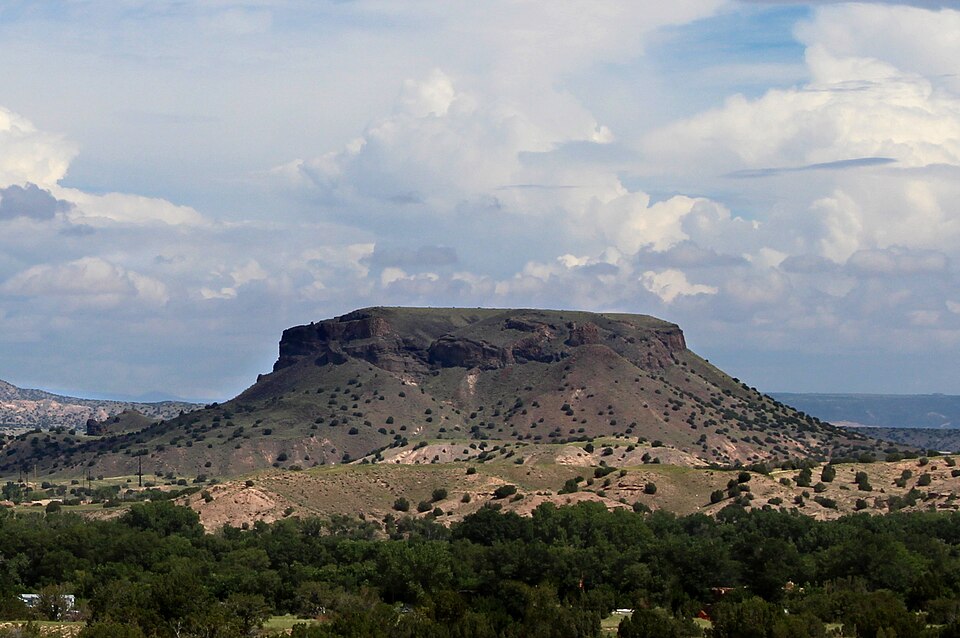
Black Mesa viewed from Road502, 4 August 2014 MARELBU / Panoramio, preserved by Wikimedia Commons · CC BY 3.0
Named roadside landscape linked to the mesa identified in the Pueblo’s public history. No cemetery, ceremony or people visible. No boundary, sacred-place interpretation, access entitlement or permission to photograph elsewhere inferred. Complete available retrieved JPEG imported unchanged. Background/card CSS crops and overlays affect presentation; the opened page retains the complete available frame proportionally.
Image, association, and reuse record reviewed 2026-10-28.
Full photographs are displayed proportionally above. A translucent background copy may be cropped by the viewport; it does not replace the complete image or its record.
The visual treatment does not change the research status, evidence, or remaining gaps recorded in this profile.
Start reading here
A short purposeful path through selected actual-content works. Read annotations for community, period and inspection limits; this is not a complete history or community endorsement.
Follow the environmental department’s selected institutional history.
These are selected starting points. The full annotated collection, source perspectives, inspection limits and remaining research questions follow below. A starting guide is not an exhaustive history or community endorsement.
01
Identity and context
San Ildefonso Pueblo is a living Pueblo nation in New Mexico.
Focus the next stage of research on: Pueblo-authored history, Tewa language context, arts and community institutions. The sources below are selected reading paths; their authorship, dates and community scope should guide how they are used.
The Pueblo’s visitor page relates an ancestral movement through Mesa Verde and Bandelier into the Rio Grande valley. It also credits Maria and Julian Martinez in its account of black-on-black pottery. This is an attributed Pueblo narrative; the guide has not independently reconstructed the full migration chronology or the artists’ careers.
San Ildefonso’s THPO describes working with an advisory board and cultural authorities to guide preservation according to Pueblo values. Public responsibilities include outreach and identifying historically significant places. This explanation does not open private knowledge or sites to unrestricted access.
The DECP traces its development through a 1992 accord, staffing and funding in 1996, and a move into a Natural Resources Building in 2002. It describes planning and risk assessment as foundations of its work. Those descriptions do not establish current environmental conditions.
Original historical records and artists’ biographies need fuller review.
Colonial chronology and legal rights are not independently settled here.
First Black Mesa photo with cemetery crosses was rejected; selected alternative is a roadside landscape without access or territory inference.
Cohort13: selected actual-content reviews preserve their institutional/community scope. Existing source cards are upgraded at the same ID and URL where noted; repeated publications are not globally new works.
Follow the reading path
Sources & further reading
Open any title to read the original source. Annotations explain what each link can help you explore.
No Indigenous-led source is identified in this entry yet. This is a gap in this collection, and does not imply an absence of community knowledge or organization.
The Pueblo presents its own historical narrative and credits Maria and Julian Martinez in black-on-black pottery. Attribution preserves the account’s perspective without independently resolving every chronology.
Inspection: Content reviewed for the stated scope
Scope: Actual HISTORY and Arts/Artists body: community-attributed Mesa Verde/Bandelier/Rio Grande movement, Tewa name, named Black Mesa and Maria/Julian Martinez account. Colonial/legal chronology and generalized lost-art claims not adopted.
Review recorded: October 28, 2026
Access note: Actual selected public body read in ordinary web reader and matching cached HTML/text on 2026-10-28. No linked media, original institutional records, private knowledge or programme evaluations inspected; descriptions and aims are not measured outcomes or current service guarantees. No outreach or access bypass.
The Pueblo explains its office’s work with cultural authorities and community guidance. Public explanation is not permission to access or photograph places.
Inspection: Content reviewed for the stated scope
Scope: Actual responsibilities body, reader lines 122–126: advisory guidance, ancestral-place protection and outreach. Linked code and inventories uninspected.
Review recorded: October 28, 2026
Access note: Actual selected public body read in ordinary web reader and matching cached HTML/text on 2026-10-28. No linked media, original institutional records, private knowledge or programme evaluations inspected; descriptions and aims are not measured outcomes or current service guarantees. No outreach or access bypass.
The department recounts its development from the 1990s into a programme linking planning, data quality and risk assessment. This institutional history is not a finding about contamination or health.
Inspection: Content reviewed for the stated scope
Scope: Actual mission and History of the DECP, reader lines 151–163: 1992 accord, 1996 staffing/funding, 2002 building, planning and risk-assessment rationale. Linked PDF, boundary graphic and sampling datasets uninspected.
Review recorded: October 28, 2026
Access note: Actual selected public body read in ordinary web reader and matching cached HTML/text on 2026-10-28. No linked media, original institutional records, private knowledge or programme evaluations inspected; descriptions and aims are not measured outcomes or current service guarantees. No outreach or access bypass.
Related entries may represent alternate names, constituent communities, wider groupings, or historical connections. Read the naming notes before treating entries as equivalent.
Robey’s Atlas of Indigenous North America · Compiled October 19, 2026 · San Ildefonso Pueblo