Warm Springs can name a constituent people as well as the contemporary confederated government that includes Wasco and Paiute people. These readings keep those histories visible while introducing language education, museum work and selected 1855 treaty provisions.
See each region’s evidence for historical or present-day scope.
Homeland / region
Pacific Northwest / Oregon
Research depth
Source guide
Source collection
5 annotated resources · 4 Indigenous-led
Inspected sources
4 substantive works · selected content reviewed
Initial adequacy
Still unfinished
Source review
October 28, 2026
A source guide for a deeper dive.This entry provides a brief orientation and an organized reading path. A comprehensive deep dive has not yet been completed. Follow the annotated sources and distinguish primary community accounts from outside reference material.
Still unfinished
A bounded actual-content starting path and specifically scoped credited picture are available. Fuller history, source comparison and community review remain open; quantity does not establish completion.
Assessment recorded October 28, 2026. This is separate from research completion and community review.
Read original treaty, constitutional and later legal records alongside the public history.
Verify current public language/museum access through programme information.
Develop more constituent-community voices rather than generalizing one institutional account.
Confluence image is modern named-waterway context, not an exact historical settlement or confirmed reservation shoreline.
Backdrop photographs & credits
These photographs have individual, documented connections to this entry. Their captions and source records define the people, place, object, and period shown; no one photograph represents every community within a broader label.
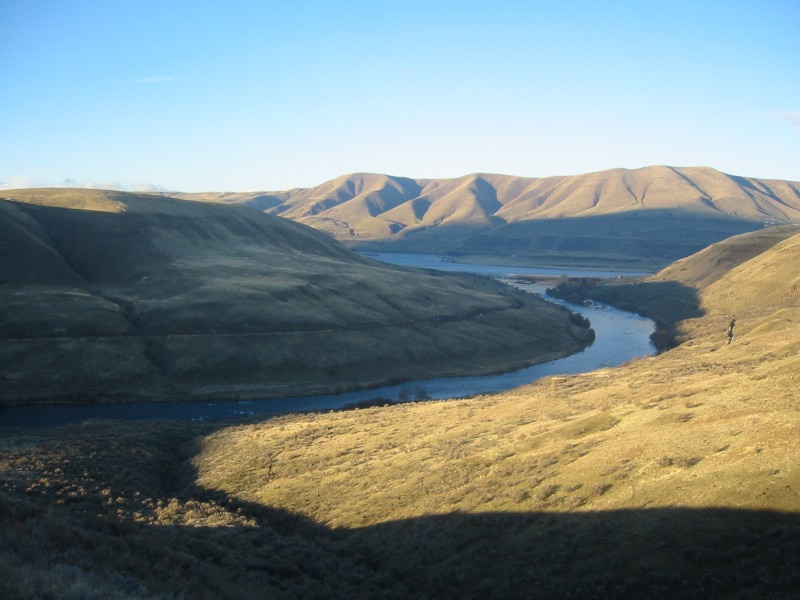
Deschutes River near the Columbia confluence Pete Forsyth, Wiki Strategies / Wikimedia Commons — CC BY 4.0
Modern Deschutes River near its Columbia confluence named-waterway context. Treaty preamble/Article1 explicitly names De Chutes bands/rivers; not exact historical village, confirmed reservation shoreline, present boundary or ownership evidence. Only available original is800×600. Complete available retrieved JPEG imported unchanged. Background/card CSS crops and overlays affect presentation; the opened page retains the complete available frame proportionally.
Image, association, and reuse record reviewed 2026-10-28.
Full photographs are displayed proportionally above. A translucent background copy may be cropped by the viewport; it does not replace the complete image or its record.
The visual treatment does not change the research status, evidence, or remaining gaps recorded in this profile.
Start reading here
A short purposeful path through selected actual-content works. Read annotations for community, period and inspection limits; this is not a complete history or community endorsement.
Compare historical narrative with selected original-agreement wording in transcription.
These are selected starting points. The full annotated collection, source perspectives, inspection limits and remaining research questions follow below. A starting guide is not an exhaustive history or community endorsement.
01
Identity and context
Warm Springs can name both a constituent people and a contemporary confederated tribal government.
Focus the next stage of research on: Distinguish Warm Springs, Wasco and Paiute histories and the confederated government. The sources below are selected reading paths; their authorship, dates and community scope should guide how they are used.
The government’s history distinguishes Sahaptin-speaking Warm Springs bands, Chinookan-speaking Wasco bands and Paiute communities. It describes different movement and settlement histories before recounting organization of the confederated government in 1937. A shared government does not make these people names interchangeable.
The programme describes language learning through schools, daycare and college settings, including Ichishkin and Kiksht. Its public mission is community language education. The page provides an introduction to methods, not assurance that each listed class is currently open or that all learners have the same experience.
The museum dates its opening to 1993 and describes workshops, archives and a library as parts of public learning. This introduces a community institution alongside the historical narrative. It does not give the Atlas permission to reproduce museum objects, displays or photographs.
The transcription names different bands and describes land, relocation and promised facilities. Its De Chutes and Columbia references provide historical named-waterway context for the modern river photograph. Neither the written provisions nor the image establishes present boundaries, implementation or ownership.
Read original treaty, constitutional and later legal records alongside the public history.
Verify current public language/museum access through programme information.
Develop more constituent-community voices rather than generalizing one institutional account.
Confluence image is modern named-waterway context, not an exact historical settlement or confirmed reservation shoreline.
Cohort11: selected actual-content reviews preserve their institutional/community scope. Existing source cards are upgraded at the same ID and URL where noted; repeated publications are not globally new works.
Follow the reading path
Sources & further reading
Open any title to read the original source. Annotations explain what each link can help you explore.
No Indigenous-led source is identified in this entry yet. This is a gap in this collection, and does not imply an absence of community knowledge or organization.
Indigenous-ledConfederated Tribes of the Warm Springs Reservation of OregonSource 1
The government distinguishes Wasco, Warm Springs and Paiute histories before explaining reservation change and twentieth-century confederation. A constituent name is not a synonym for all three peoples.
Inspection: Content reviewed for the stated scope
Scope: Actual full main historical body read: The Wascoes, The Warm Springs, The Paiutes, Arrival of Settlers, Early Reservation Years, Paiute Settlement and Tribal Government/Indian Self-Determination. Synthesis excludes numeric migration/territory claims.
Review recorded: October 28, 2026
Access note: Actual selected public content read on 2026-10-28 through normalHTTP200, ordinary web reader or stated PDF pages. No access bypass or outreach. Linked originals, recordings, images and full collections were not automatically reviewed or licensed. NormalHTTP200 HTML. Underlying treaties, constitution, charter and historical records not inspected here. Historical generalizations about livelihoods are scoped to this account, not every family/current identity.
The public programme page explains different language-education settings and names Ichishkin and Kiksht classes. It is an instructional-method introduction rather than a current timetable guarantee.
Inspection: Content reviewed for the stated scope
Scope: Actual About/Language Classes, Mission, eligibility andFAQ body. Selected school/daycare/college learning settings and education mission. No application, lesson, recording or class attended.
Review recorded: October 28, 2026
Access note: Actual selected public content read on 2026-10-28 through normalHTTP200, ordinary web reader or stated PDF pages. No access bypass or outreach. Linked originals, recordings, images and full collections were not automatically reviewed or licensed. NormalHTTP200 HTML. Undated scheduling, credit and eligibility details are not current access advice; no learner outcomes or current speaker totals inferred.
Community or Indigenous-organization perspective linked for this entry. Use “Languages – Visit Warm Springs” to begin with the publisher’s own account; check whether its scope is one community or a wider people.
The museum’s own introduction links community support and its 1993 opening with public learning, archives and workshops. Collection superlatives and quantities are not adopted as independently verified.
Inspection: Content reviewed for the stated scope
Scope: Actual complete About Us/The Big Picture body:1974 project support, March13, 1993 opening, educational workshops and archival/library functions. No object, photograph, display or underlying archive reviewed.
Review recorded: October 28, 2026
Access note: Actual selected public content read on 2026-10-28 through normalHTTP200, ordinary web reader or stated PDF pages. No access bypass or outreach. Linked originals, recordings, images and full collections were not automatically reviewed or licensed. NormalHTTP200 HTML. Undated programme availability and accession plans not confirmed. Text is not a reuse license for objects, artwork or photographs.
The community-hosted transcription names distinct bands and sets out reservation, relocation, payment and institutional provisions. Historical wording is not current legal advice or proof of implementation.
Inspection: Content reviewed for the stated scope
Scope: Actual preamble and complete Articles1–4 read. Selected band names, De Chutes/Columbia geography, relocation and promised buildings/support. No original manuscript, subsequent statutes or judgments inspected.
Review recorded: October 28, 2026
Access note: Actual selected public content read on 2026-10-28 through normalHTTP200, ordinary web reader or stated PDF pages. No access bypass or outreach. Linked originals, recordings, images and full collections were not automatically reviewed or licensed. NormalHTTP200 HTML. Period band labels are retained only as period wording, not new aliases/governments. No unanimous assent, fulfillment, present title/boundary or exact village inference.
Related entries may represent alternate names, constituent communities, wider groupings, or historical connections. Read the naming notes before treating entries as equivalent.
Robey’s Atlas of Indigenous North America · Compiled October 19, 2026 · Warm Springs