Wasco communities have distinct Columbia River histories within the Confederated Tribes of Warm Springs. This route foregrounds the government’s Wasco account and Kiksht learning context, then introduces a museum serving the shared community.
See each region’s evidence for historical or present-day scope.
Homeland / region
Pacific Northwest / Oregon / Washington
Research depth
Source guide
Source collection
5 annotated resources · 3 Indigenous-led
Inspected sources
3 substantive works · selected content reviewed
Initial adequacy
Still unfinished
Source review
October 28, 2026
A source guide for a deeper dive.This entry provides a brief orientation and an organized reading path. A comprehensive deep dive has not yet been completed. Follow the annotated sources and distinguish primary community accounts from outside reference material.
Still unfinished
A bounded actual-content starting path and specifically scoped credited picture are available. Fuller history, source comparison and community review remain open; quantity does not establish completion.
Assessment recorded October 28, 2026. This is separate from research completion and community review.
Read Wasco-authored language/history scholarship and more family/community perspectives.
Inspect primary treaty, removal and local river-history records.
Verify current Kiksht and museum access independently of undated descriptions.
Three sources overlap with Warm Springs:three profile contexts are not three globally new publications.
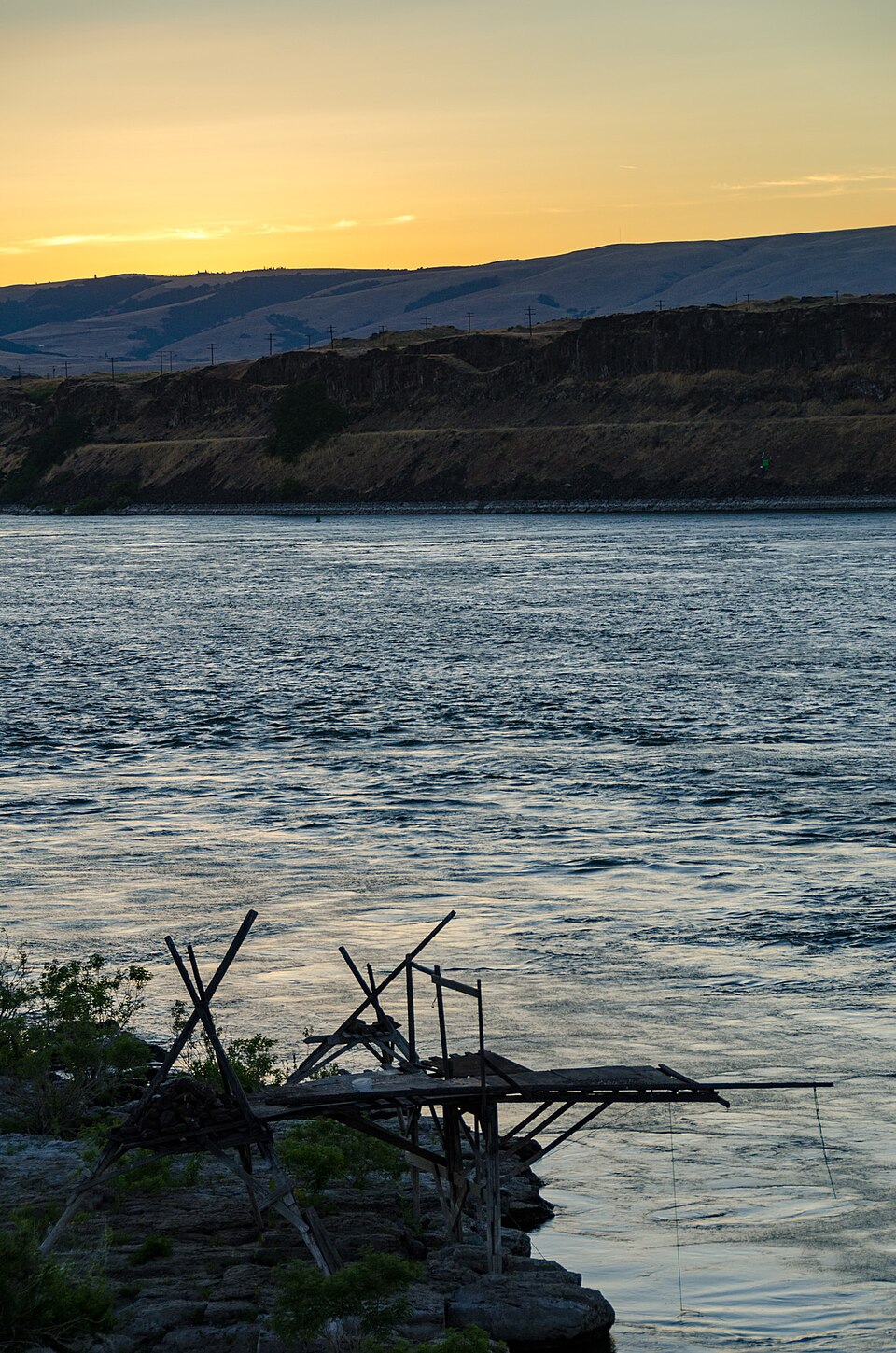
The Dalles photograph is a modern Columbia River view, not a confirmed village or current boundary.
Backdrop photographs & credits
These photographs have individual, documented connections to this entry. Their captions and source records define the people, place, object, and period shown; no one photograph represents every community within a broader label.
Columbia River sunset at The Dalles Gary Halvorson, Oregon State Archives / Wikimedia Commons — CC BY 4.0
Modern Columbia River at The Dalles, as specifically supported regional context for Wasco history. Not a confirmed historic village, traditional dam-free scene or current boundary. DPLA coordinatefields point to archive location rather than depicted site; no exact coordinates used. Foreground fishing platform is visible; its builder, owner, date and community users are unidentified and not inferred. No fishing-site coordinates or access instructions published. Complete available retrieved JPEG imported unchanged. Background/card CSS crops and overlays affect presentation; the opened page retains the complete available frame proportionally.
Image, association, and reuse record reviewed 2026-10-28.
Full photographs are displayed proportionally above. A translucent background copy may be cropped by the viewport; it does not replace the complete image or its record.
The visual treatment does not change the research status, evidence, or remaining gaps recorded in this profile.
Start reading here
A short purposeful path through selected actual-content works. Read annotations for community, period and inspection limits; this is not a complete history or community endorsement.
Read the museum’s shared-community history and learning purpose.
These are selected starting points. The full annotated collection, source perspectives, inspection limits and remaining research questions follow below. A starting guide is not an exhaustive history or community endorsement.
01
Identity and context
Wasco people have homelands around the middle Columbia River and distinct histories within contemporary confederated communities.
Focus the next stage of research on: Chinookan language context, fishing, trade and tribal institutions. The sources below are selected reading paths; their authorship, dates and community scope should guide how they are used.
The government’s history describes Wasco bands as Chinookan-speaking Columbia River communities with extensive trade relationships. It distinguishes them from neighboring Warm Springs bands and later Paiute settlement. Shared political institutions are part of that history, not a reason to erase the Wasco name.
The public Language Program identifies Kiksht college classes alongside other learning settings in the confederated community. This is a specifically relevant route for Wasco readers. The undated listing does not confirm present enrollment, credit availability or learner outcomes.
The Museum at Warm Springs explains its history, workshops and archival/library role as an institution of the Confederated Tribes. Wasco history belongs in that shared setting, while individual objects and accounts require their own identification and permissions. The Columbia photograph is regional setting rather than a village or territorial map.
Read Wasco-authored language/history scholarship and more family/community perspectives.
Inspect primary treaty, removal and local river-history records.
Verify current Kiksht and museum access independently of undated descriptions.
Three sources overlap with Warm Springs:three profile contexts are not three globally new publications.
The Dalles photograph is a modern Columbia River view, not a confirmed village or current boundary.
Cohort11: selected actual-content reviews preserve their institutional/community scope. Existing source cards are upgraded at the same ID and URL where noted; repeated publications are not globally new works.
Follow the reading path
Sources & further reading
Open any title to read the original source. Annotations explain what each link can help you explore.
No Indigenous-led source is identified in this entry yet. This is a gap in this collection, and does not imply an absence of community knowledge or organization.
Indigenous-ledConfederated Tribes of the Warm Springs Reservation of OregonSource 1
The shared government’s account gives specific Wasco/Columbia River context while keeping Warm Springs and Paiute histories distinct. This is the same work reviewed on the Warm Springs route, not another globally new publication.
Inspection: Content reviewed for the stated scope
Scope: Actual full main historical body read: The Wascoes, The Warm Springs, The Paiutes, Arrival of Settlers, Early Reservation Years, Paiute Settlement and Tribal Government/Indian Self-Determination. Synthesis excludes numeric migration/territory claims.
Review recorded: October 28, 2026
Access note: Actual selected public content read on 2026-10-28 through normalHTTP200, ordinary web reader or stated PDF pages. No access bypass or outreach. Linked originals, recordings, images and full collections were not automatically reviewed or licensed. NormalHTTP200 HTML. Underlying treaties, constitution, charter and historical records not inspected here. Historical generalizations about livelihoods are scoped to this account, not every family/current identity.
Historical context for this entry. Read “Wasco, and Yamel.” with attention to the author, period covered, and communities named; compare with community-published accounts where available.
Historical context for this entry. Read “Historical and cultural reference for Wasco” with attention to the author, period covered, and communities named; compare with community-published accounts where available.
The programme’s actual Kiksht-class explanation is a specific Wasco-language learning route within the shared government. Same work as the Warm Springs context, not another globally new publication.
Inspection: Content reviewed for the stated scope
Scope: Actual About/Language Classes, Mission, eligibility andFAQ body. Selected school/daycare/college learning settings and education mission. No application, lesson, recording or class attended.
Review recorded: October 28, 2026
Access note: Actual selected public content read on 2026-10-28 through normalHTTP200, ordinary web reader or stated PDF pages. No access bypass or outreach. Linked originals, recordings, images and full collections were not automatically reviewed or licensed. NormalHTTP200 HTML. Undated scheduling, credit and eligibility details are not current access advice; no learner outcomes or current speaker totals inferred.
The shared museum’s history and public-learning explanation provides institutional context for Wasco readers without claiming an exclusively Wasco collection. Same underlying work as the Warm Springs route.
Inspection: Content reviewed for the stated scope
Scope: Actual complete About Us/The Big Picture body:1974 project support, March13, 1993 opening, educational workshops and archival/library functions. No object, photograph, display or underlying archive reviewed.
Review recorded: October 28, 2026
Access note: Actual selected public content read on 2026-10-28 through normalHTTP200, ordinary web reader or stated PDF pages. No access bypass or outreach. Linked originals, recordings, images and full collections were not automatically reviewed or licensed. NormalHTTP200 HTML. Undated programme availability and accession plans not confirmed. Text is not a reuse license for objects, artwork or photographs.
Related entries may represent alternate names, constituent communities, wider groupings, or historical connections. Read the naming notes before treating entries as equivalent.
Robey’s Atlas of Indigenous North America · Compiled October 19, 2026 · Wasco