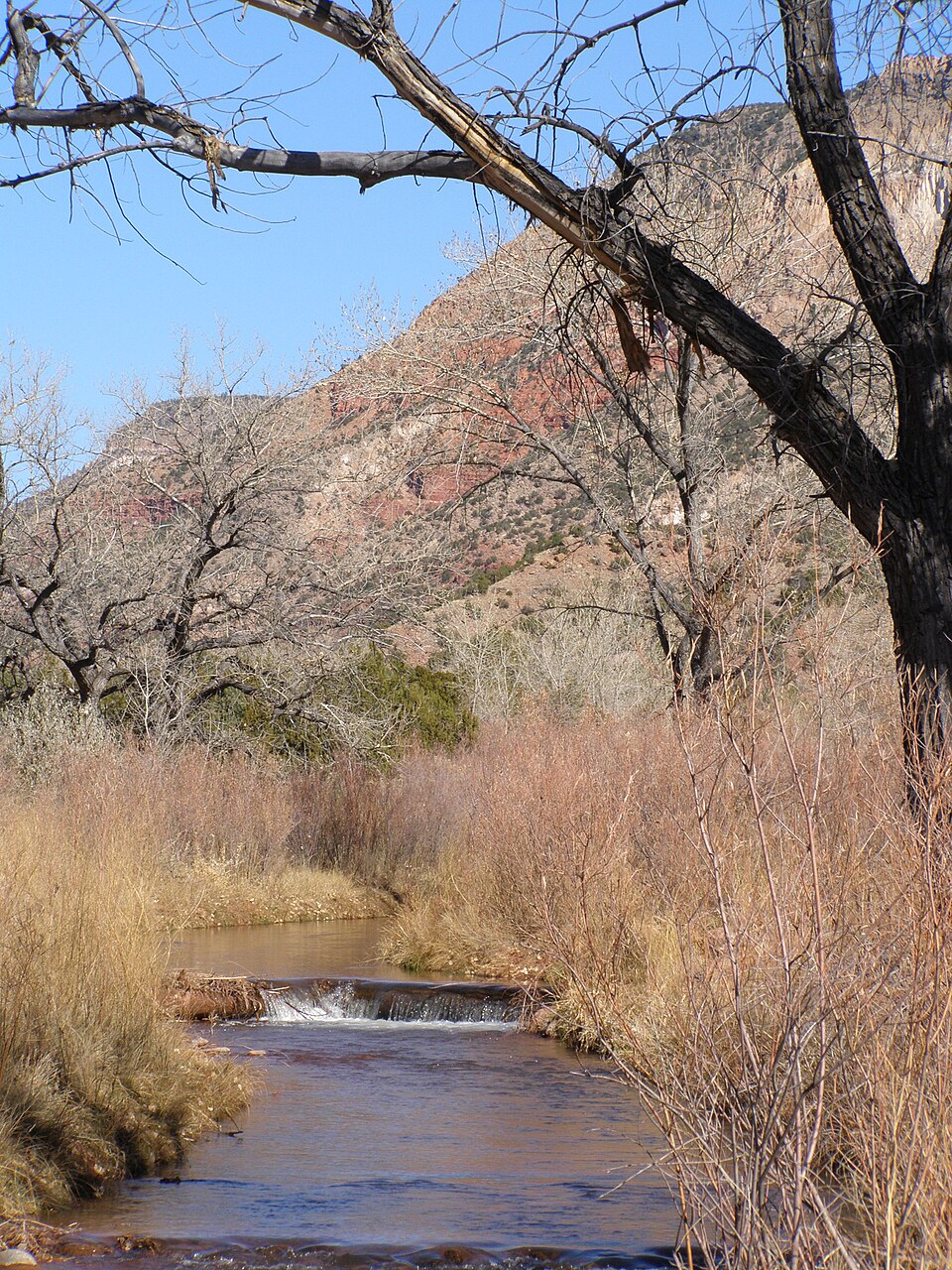
Jemez River downstream from Jemez Pueblo, November 15, 2008Sharon Phelan Evans (Stphelan) / Photographer’s own work, via Wikimedia Commons · CC BY-SA 3.0
Zia Pueblo is a Keres-speaking community in New Mexico. Its own public historical introduction and language programme account offer a compact starting path through farming, community history and teaching, without treating a short guide as a complete account of Zia life.
See each region’s evidence for historical or present-day scope.
Homeland / region
Southwest / New Mexico
Research depth
Source guide
Source collection
4 annotated resources · 2 Indigenous-led
Inspected sources
2 substantive works · selected content reviewed
Initial adequacy
Still unfinished
Source review
October 28, 2026
A source guide for a deeper dive.This entry provides a brief orientation and an organized reading path. A comprehensive deep dive has not yet been completed. Follow the annotated sources and distinguish primary community accounts from outside reference material.
Still unfinished
A bounded actual-content starting path and specifically scoped credited picture are available. Fuller history, source comparison and community review remain open; quantity does not establish completion.
Assessment recorded October 28, 2026. This is separate from research completion and community review.
Still unfinished: fuller Pueblo-authored history and dated language-programme documentation remain useful.
No rights-cleared Pueblo village, cultural-object or symbol image was selected.
The image shows another documented reach of the shared Jemez River, downstream from Jemez Pueblo, not a view of Zia Pueblo or its reservation.
Backdrop photographs & credits
These photographs have individual, documented connections to this entry. Their captions and source records define the people, place, object, and period shown; no one photograph represents every community within a broader label.
Jemez River downstream from Jemez Pueblo, November 15, 2008 Sharon Phelan Evans (Stphelan) / Photographer’s own work, via Wikimedia Commons · CC BY-SA 3.0
Another specifically identified reach of the shared Jemez River, downstream from Jemez Pueblo. The selected USACE paragraph documents Zia’s Jemez-watershed connection. This is NOT a photograph of Zia Pueblo, a Zia reservation shore, a Zia-made object or evidence of jurisdiction. Exact coordinates were not established; no water-quality or access claim. Complete available retrieved JPEG imported unchanged. Background/card CSS crops and overlays affect presentation; the opened page retains the complete available frame proportionally.
Image, association, and reuse record reviewed 2026-10-28.
Full photographs are displayed proportionally above. A translucent background copy may be cropped by the viewport; it does not replace the complete image or its record.
The visual treatment does not change the research status, evidence, or remaining gaps recorded in this profile.
Start reading here
A short purposeful path through selected actual-content works. Read annotations for community, period and inspection limits; this is not a complete history or community endorsement.
Follow the Pueblo’s account of language teaching across age groups.
These are selected starting points. The full annotated collection, source perspectives, inspection limits and remaining research questions follow below. A starting guide is not an exhaustive history or community endorsement.
01
Identity and context
Zia Pueblo is a living Pueblo nation in New Mexico.
Focus the next stage of research on: Pueblo-authored history, Keres language context and community government. The sources below are selected reading paths; their authorship, dates and community scope should guide how they are used.
The Pueblo’s public account describes a Keres-speaking community, adobe construction and the cultivation of corn, beans and squash. These selected paragraphs provide an introduction rather than a settled chronology of every phase of Zia history. Ceremonial material and the permission-restricted Zia sun symbol are not reproduced.
The language programme describes instruction for young children, youth and adults, including educational partnerships. Its stated aims connect learning with community identity and persistence. The undated description reports goals and activities; it does not establish current class schedules or independently measured language outcomes.
Still unfinished: fuller Pueblo-authored history and dated language-programme documentation remain useful.
No rights-cleared Pueblo village, cultural-object or symbol image was selected.
The image shows another documented reach of the shared Jemez River, downstream from Jemez Pueblo, not a view of Zia Pueblo or its reservation.
Cohort13: selected actual-content reviews preserve their institutional/community scope. Existing source cards are upgraded at the same ID and URL where noted; repeated publications are not globally new works.
Follow the reading path
Sources & further reading
Open any title to read the original source. Annotations explain what each link can help you explore.
No Indigenous-led source is identified in this entry yet. This is a gap in this collection, and does not imply an absence of community knowledge or organization.
The Pueblo homepage contains an actual public historical introduction about its Keres-speaking community, adobe architecture and farming. Only that substantive body is counted.
Inspection: Content reviewed for the stated scope
Scope: Actual selected History main-body paragraphs: Keres-speaking identity, settlement/architecture descriptions and corn-bean-squash agriculture. Navigation, ceremonial descriptions and symbol permissions are not historical evidence for this synthesis.
Review recorded: October 28, 2026
Access note: Actual selected public content inspected on 2026-10-28. No access bypass or outreach. Linked media are not cleared by this textual review. Exact founding chronology is not resolved. No present population, boundary or universal cultural practice is inferred. The page restricts use of the Zia sun symbol; no emblem or protected motif is copied.
The Pueblo’s public language programme account describes work with early childhood, youth and adult learners and partnerships with educational settings.
Inspection: Content reviewed for the stated scope
Scope: Actual complete substantive programme body, ordinary web-reader lines 13–17: early childhood/youth/adult teaching, school partnerships, Head Start/childcare lessons and stated programme aims.
Review recorded: October 28, 2026
Access note: Actual selected public content inspected on 2026-10-28. No access bypass or outreach. Linked media are not cleared by this textual review. Undated programme description. Goals and reported activities do not establish current availability, participation or measured fluency outcomes. No lessons, ceremonies or restricted knowledge reproduced.
Context and further reading linked for this entry. The publisher’s “Zia Pueblo - eHRAF World Cultures” is a starting point; verify the geographical and community scope before applying its account more broadly.
A short agency project description explicitly places Zia’s watershed planning within the Jemez River watershed. It supplies narrow shared-waterbody image context.
Inspection: Supporting or limited review; see scope
Scope: Actual indexed agency body of approximately 130 words: proposed watershed management for Pueblo lands in the Jemez River watershed and listed sediment, erosion, habitat and resource concerns.
Review recorded: October 28, 2026
Access note: Direct normal retrieval returned HTTP 403; actual substantial indexed project paragraph was read, not the full report, maps or underlying assessment. No bypass. Supporting place/project context only and excluded from substantive work counts. Goals are not verified outcomes; no image coordinates or reservation location are inferred.
Related entries may represent alternate names, constituent communities, wider groupings, or historical connections. Read the naming notes before treating entries as equivalent.
Robey’s Atlas of Indigenous North America · Compiled October 19, 2026 · Zia Pueblo