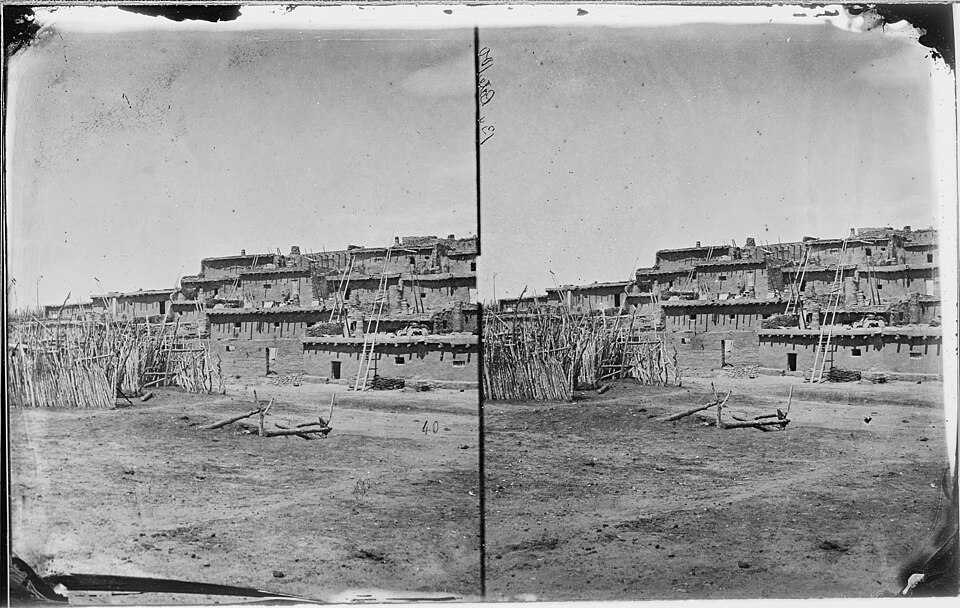
Zuni Pueblo exterior, stereoscopic double view, 1873Photographer not identified in the NARA item / U.S. National Archives, NAID 519764 /77-WF-40; War Department geographical surveys west of the 100 thmeridian · Public domain — U.S. federal survey work; Public Domain Mark 1.0 at the media record
Zuni’s museum account presents historical learning as community work, including how collections and outside representations are handled. An architectural history and an agency account of Hawikuh provide distinct starting perspectives; the 1873 exterior photograph is a dated outside record, not contemporary community life.
See each region’s evidence for historical or present-day scope.
Homeland / region
Southwest / New Mexico
Research depth
Source guide
Source collection
5 annotated resources · 2 Indigenous-led
Inspected sources
3 substantive works · selected content reviewed
Initial adequacy
Still unfinished
Source review
October 28, 2026
A source guide for a deeper dive.This entry provides a brief orientation and an organized reading path. A comprehensive deep dive has not yet been completed. Follow the annotated sources and distinguish primary community accounts from outside reference material.
Still unfinished
A bounded actual-content starting path and specifically scoped credited picture are available. Fuller history, source comparison and community review remain open; quantity does not establish completion.
Assessment recorded October 28, 2026. This is separate from research completion and community review.
Read fuller Zuni-authored history and appropriately public archival records.
Museum and tourism websites had SSL/time-out limits; the Nation-hosted 2021 feature supplied the inspected community account.
Compare differing excavation chronologies against original records before asserting a start year.
No ceremonial material, collection image or current visitor permission is supplied.
Backdrop photographs & credits
These photographs have individual, documented connections to this entry. Their captions and source records define the people, place, object, and period shown; no one photograph represents every community within a broader label.
Zuni Pueblo exterior, stereoscopic double view, 1873 Photographer not identified in the NARA item / U.S. National Archives, NAID 519764 /77-WF-40; War Department geographical surveys west of the 100 thmeridian · Public domain — U.S. federal survey work; Public Domain Mark 1.0 at the media record
Outside nineteenth-century federal-survey exterior view explicitly identified as Zuni Pueblo. Photographer remains unknown in this item; no inferred O’Sullivan attribution. Not a current portrait or unrestricted visitor/photography permission. The entire paired stereoscopic image is retained; neither half is isolated or recombined. Complete available retrieved JPEG imported unchanged. Background/card CSS crops and overlays affect presentation; the opened page retains the complete available frame proportionally.
Image, association, and reuse record reviewed 2026-10-28.
Full photographs are displayed proportionally above. A translucent background copy may be cropped by the viewport; it does not replace the complete image or its record.
The visual treatment does not change the research status, evidence, or remaining gaps recorded in this profile.
Start reading here
A short purposeful path through selected actual-content works. Read annotations for community, period and inspection limits; this is not a complete history or community endorsement.
Follow the museum building’s changing uses through architectural scholarship.
These are selected starting points. The full annotated collection, source perspectives, inspection limits and remaining research questions follow below. A starting guide is not an exhaustive history or community endorsement.
01
Identity and context
The Pueblo of Zuni is a living nation with its own language, history and institutions.
Focus the next stage of research on: A:shiwi self-designation, language, land and Zuni-authored histories. The sources below are selected reading paths; their authorship, dates and community scope should guide how they are used.
The 2021 museum feature dates the institution’s beginnings to 1992 and explains learning and reflection as its purpose. It describes collaboration with collecting institutions to challenge inaccurate representations and improve community access and control. Those stated purposes do not grant visitors access to private knowledge or permission to reproduce collections.
Burgio-Ericson’s architectural account follows a former trading post’s adaptation into the museum. It relates that reuse to youth learning, archives and collaboration. This selected indexed account offers historical building context; its photographs and underlying records were not inspected.
NPS discusses Hawikuh, violent Spanish contact and later colonial conflict. The museum feature presents its own exhibition as a way to learn that history from Zuni perspectives and also questions the legacy of collecting and excavation. Read these accounts together; this guide does not reproduce ceremonial material or infer an unrestricted right to visit.
Read fuller Zuni-authored history and appropriately public archival records.
Museum and tourism websites had SSL/time-out limits; the Nation-hosted 2021 feature supplied the inspected community account.
Compare differing excavation chronologies against original records before asserting a start year.
No ceremonial material, collection image or current visitor permission is supplied.
Cohort12: selected actual-content reviews preserve their institutional/community scope. Existing source cards are upgraded at the same ID and URL where noted; repeated publications are not globally new works.
Follow the reading path
Sources & further reading
Open any title to read the original source. Annotations explain what each link can help you explore.
No Indigenous-led source is identified in this entry yet. This is a gap in this collection, and does not imply an absence of community knowledge or organization.
NPS follows Hawikuh’s occupation and violent Spanish contact, then later colonial conflict and excavation. It is an outside heritage interpretation to compare with Zuni accounts.
Inspection: Content reviewed for the stated scope
Scope: Actual historical main body, reader lines 42–61, and updated date 25 July 2023. Specific burial, religious-practice and site-access details are not synthesized; linked underlying records uninspected.
Review recorded: October 28, 2026
Access note: Normal public body read. The page contains repeated excavation paragraphs and differing 1917/1918 start wording compared with the museum account; no excavation-start date is asserted. Colonial discovery wording and broad ancestry claims are not adopted.
The obtained ten-page legislative-hosted scan is retained as an unread lead, excluded from substantive counts.
Inspection: Content review not recorded
Access recorded: October 28, 2026
Access note: Normal HTTP 200 PDF obtained; text extraction empty. No pages rendered or visually inspected; no document-author identity inferred from the archive host.
The Pueblo’s brochure invites learning while emphasizing cultural privacy. It is supporting orientation, not an additional substantive historical study.
Inspection: Supporting or limited review; see scope
Scope: Actual text of both PDF pages; invitation, cultural-privacy statements and listed museum/arts learning routes. Visitor rules and current schedules are not reproduced as guidance.
Review recorded: October 28, 2026
Access note: Normal HTTP 200 two-page PDF/text read. Legislative-hosted copy is an older public brochure; no current visitor permission or religious access follows from its publication.
A museum-authored feature explains its 1992 community beginnings, education work and collaborations intended to correct outside representations and improve community control of knowledge.
Inspection: Content reviewed for the stated scope
Scope: Actual complete article on printed/PDF p 5, A:shiwi A:wan Museum and Heritage Center: a Forum for Zuni History and Art; masthead date 12 November 2021 on p 1. Sixteen-page newsletter obtained but not fully read.
Review recorded: October 28, 2026
Access note: Normal HTTP 200 PDF/text read; www URL redirects to ashiwi.org. Private 33 MBsource copy is not a Site asset. Exhibitions, archival films, collections and linked artwork were not inspected or reproduced.
An architectural historian traces a former trading post’s transformation into a community museum, relating building adaptation to educational purposes.
Inspection: Content reviewed for the stated scope
Scope: Actual substantial indexed main-body paragraphs from former trading post introduction through restoration, museum adaptation, youth programmes and collaborations; displayed citation and chronology read.
Review recorded: October 28, 2026
Access note: Direct reader and normal HTTP retrieval returned 403; only the substantive indexed body was inspected. No whole-site, photograph or original building-record inspection is claimed.
Related entries may represent alternate names, constituent communities, wider groupings, or historical connections. Read the naming notes before treating entries as equivalent.
Robey’s Atlas of Indigenous North America · Compiled October 19, 2026 · Zuni