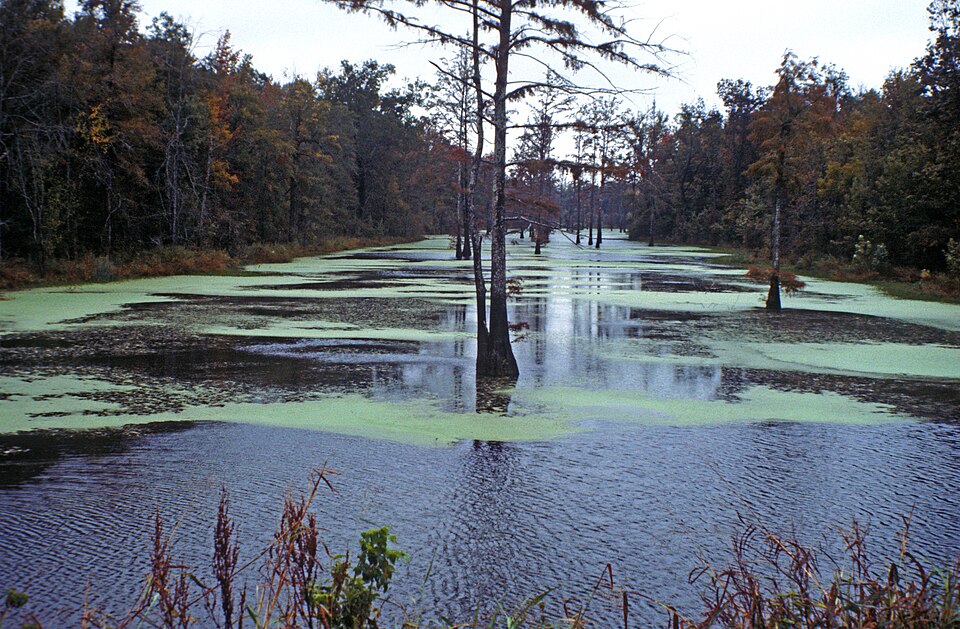
Quapaw Nation publications provide paths into naming, language renewal, family histories and source comparison. A community-authored chronology introduces nineteenth-century movements, while a selected 2026 Culture Division report documents dated institutional work. The bayou photograph supplies modern Arkansas Post context rather than a portrait of the Nation or a territorial boundary.
See each region’s evidence for historical or present-day scope.
Homeland / region
Great Plains / Arkansas / Oklahoma
Research depth
Source guide
Source collection
9 annotated resources · 8 Indigenous-led
Inspected sources
6 substantive works · selected content reviewed
Initial adequacy
Still unfinished
Source review
October 28, 2026
A source guide for a deeper dive.This entry provides a brief orientation and an organized reading path. A comprehensive deep dive has not yet been completed. Follow the annotated sources and distinguish primary community accounts from outside reference material.
Still unfinished
A bounded actual-content starting path and specifically scoped credited picture are available. Fuller history, source comparison and community review remain open; quantity does not establish completion.
Assessment recorded October 28, 2026. This is separate from research completion and community review.
Read original removal, treaty and migration records and compare the compressed chronology.
Preserve uncertainty in Saracen’s biography rather than choosing a familiar legend.
Inspect linked language materials and oral-history recordings only within their actual access and community guidance.
The reused Culture Division document URL may serve a newer body in the future.
Backdrop photographs & credits
These photographs have individual, documented connections to this entry. Their captions and source records define the people, place, object, and period shown; no one photograph represents every community within a broader label.
Bayous around Arkansas Post, 2007 JERRYE & ROY KLOTZ MD / Wikimedia Commons · CC BY-SA 3.0; source crop by Ruhrfisch/Cropbot
Modern landscape around Arkansas Post as identified by its photographer. The NPS historical overview supports the Post’s Quapaw connection and explicitly notes relocations. This does not place the camera at the original Osotouy village or establish present ownership, reserve boundaries or ecological conditions elsewhere. The provider’s current image is an already-cropped 2013 derivative of the 2007 photograph; the complete available960px preview of that derivative was inspected. No further Atlas pixel crop. Complete available retrieved JPEG imported unchanged. Background/card CSS crops and overlays affect presentation; the opened page retains the complete available frame proportionally.
Image, association, and reuse record reviewed 2026-10-28.
Full photographs are displayed proportionally above. A translucent background copy may be cropped by the viewport; it does not replace the complete image or its record.
The visual treatment does not change the research status, evidence, or remaining gaps recorded in this profile.
Start reading here
A short purposeful path through selected actual-content works. Read annotations for community, period and inspection limits; this is not a complete history or community endorsement.
Read a specifically dated report of cultural-institution work.
These are selected starting points. The full annotated collection, source perspectives, inspection limits and remaining research questions follow below. A starting guide is not an exhaustive history or community endorsement.
01
Identity and context
Quapaw people have ancestral homelands in the Mississippi Valley and a contemporary nation in Oklahoma.
Focus the next stage of research on: Ogáxpa naming, language, removal and nation-published history. The sources below are selected reading paths; their authorship, dates and community scope should guide how they are used.
The Nation connects its downstream name with an attributed migration history and compares forms used in related Dhegiha languages. Its Language Department describes both shared ties and the distinct languages of the participating nations. These relationships should not be read as a single present government.
Removal, return and the limits of a familiar story
Risë Supernaw Proctor’s chronology offers a route into nineteenth-century movements. Everett Bandy’s account of Saracen explains that pressure for land, removal to the Red River, floods, returns and further removal did not form a simple one-way journey. Bandy also compares retellings with older evidence and leaves parts of Saracen’s life unresolved. Underlying records need separate review.
The Language Department describes its website as an evolving reference for the Nation, with a dictionary, historical documents and learning resources. The Culture Division’s September 2026 report describes work on an allotment exhibit, language curriculum and a public history summit. These are dated departmental reports, rather than an audit of lasting outcomes.
The Library’s October 2026 Voices from the Past project describes descendants sharing histories across generations. The linked recording has not been reviewed here. Separately, the National Park Service places the first Arkansas Post at Osotouy and records later relocations. A 2007 bayou view around Arkansas Post provides modern landscape context; it does not identify a former village, a grave, or the boundaries of Quapaw land.
Read original removal, treaty and migration records and compare the compressed chronology.
Preserve uncertainty in Saracen’s biography rather than choosing a familiar legend.
Inspect linked language materials and oral-history recordings only within their actual access and community guidance.
The reused Culture Division document URL may serve a newer body in the future.
Cohort10: selected actual-content reviews preserve their institutional/community scope. Existing source cards are upgraded at the same ID and URL where noted; repeated publications are not globally new works.
Follow the reading path
Sources & further reading
Open any title to read the original source. Annotations explain what each link can help you explore.
No Indigenous-led source is identified in this entry yet. This is a gap in this collection, and does not imply an absence of community knowledge or organization.
Navigation index to Nation cultural resources. Reviewed as a route and evidence of its link to the community-authored chronology; not a standalone substantive history.
Inspection: Supporting or limited review; see scope
Scope: Actual Culture-page headings and explanatory navigation, selected lines16–68 on the canonical equivalent without mobile query.
Review recorded: October 28, 2026
Access note: The saved query-string URL is retained. Navigation is excluded from substantive source counts.
The actual retrieved PDF reports September 2026 museum, language, library and historic-preservation work. The URL says June and file metadata says October; the reporting period in the body controls this review.
Inspection: Content reviewed for the stated scope
Scope: Actual selected PDFpp1–3: reporting-period line, museum exhibit update, language-development paragraphs and public history-summit account; web-extracted lines1–15, 23–42, 66–71.
Review recorded: October 28, 2026
Access note: A reused document endpoint can change over time. This review identifies the September 2026 body, not the June named in its URL. Photos were not reused or claimed visually inspected. Visitor/sales/project totals, sensitive instruction and planned-event outcomes are not adopted.
A differently labelled route to the same DocumentCenter12960 item. Retained as an excluded duplicate/dynamic-document lead; no independent May 2026 report inspection is claimed.
Inspection: Content review not recorded
Access recorded: October 19, 2026
Counting note: Same document identifier12960; not another distinct work.
The Nation explains its downstream name through its own migration account and compares related language forms. Oral history is attributed; language relationship does not merge distinct nations.
Inspection: Content reviewed for the stated scope
Scope: Actual public Downstream People and language-comparison/credit body, lines17–44.
Review recorded: October 28, 2026
Access note: Linked audio not played. No original speakers’ recordings or comparative linguistic publications independently inspected; spellings remain source-specific.
The department explains its reference tools, historical archive and language-renewal purpose. It discusses relationships with other Dhegiha languages while explicitly preserving each Nation’s distinct language.
Inspection: Content reviewed for the stated scope
Scope: Actual Our Purpose, Dhegiha Language Resources and acknowledgments, lines10–23; official departmental authorship at26 and page date47.
Review recorded: October 28, 2026
Access note: Dictionary, linked archives, audio/video and lessons not inspected. No independent present-speaker census or disappearance inference; goals are not learning-outcome measurements.
Bandy compares retellings with an 1827 account and discusses forced movement, returns and uncertain details of Saracen’s life. The discussion models why a familiar monument or legend cannot settle a historical question.
Inspection: Content reviewed for the stated scope
Scope: Actual selected biography/source-comparison/removal and uncertainty body, lines19–59, and displayed bibliography60–71.
Review recorded: October 28, 2026
Access note: Underlying letters, treaties, muster rolls and cited scholarship were not separately read. Exact birth/death dates and disputed movements remain unresolved; quoted colonial/racial language is not adopted.
A community-authored chronology offers leads into removal, changing residences and wartime disruption. Individual compressed entries require fuller records and comparison; this is one compilation.
Inspection: Content reviewed for the stated scope
Scope: Actual selected dated entries 1824–1877, web lines21–41, plus compiler credit. The Nation Culture page links this exact document as History.
Review recorded: October 28, 2026
Access note: Early precontact assertions, older population totals, extended racial/adoption terminology and unseen underlying records are not adopted. Not every line is independently verified.
The Library describes its October24, 2026 project and the role of descendants’ memories in sharing family and community history. Its public project account is distinct from the underlying presentations.
Inspection: Content reviewed for the stated scope
Scope: Actual project description, selected individual summaries and preservation/acknowledgment paragraphs, lines18–25, 35–44, 54–65.
Review recorded: October 28, 2026
Access note: Video not watched; no full oral-history inspection claimed. Cemetery locations, grave markers and ceremonial details are not republished. Programme interpretation remains attributed to the Library.
This federal-site overview explicitly places the 1686 trading post at the Quapaw village of Osotouy and explains that the post moved over time. It provides a narrowly scoped place connection for a modern bayou photograph.
Inspection: Supporting or limited review; see scope
Scope: Actual history body lines22–24 and displayed date25.
Review recorded: October 28, 2026
Access note: The modern photograph is not a picture of the seventeenth-century village or the first post’s exact site. Underlying colonial records and linked battle article uninspected.
Counting note: Direct place/identity support; only one founding sentence concerns Quapaw, so excluded from substantive history-source counts after independent review.
Related entries may represent alternate names, constituent communities, wider groupings, or historical connections. Read the naming notes before treating entries as equivalent.
Robey’s Atlas of Indigenous North America · Compiled October 19, 2026 · Quapaw