Cayuga is one of the Haudenosaunee peoples. This starting path brings together a dated Cayuga council publication from New York and language work at Six Nations of the Grand River; those contexts should not be collapsed into a single present government.
See each region’s evidence for historical or present-day scope.
Homeland / region
Northeast / Haudenosaunee
Research depth
Source guide
Source collection
5 annotated resources · 5 Indigenous-led
Inspected sources
3 substantive works · selected content reviewed
Initial adequacy
Still unfinished
Source review
October 28, 2026
A source guide for a deeper dive.This entry provides a brief orientation and an organized reading path. A comprehensive deep dive has not yet been completed. Follow the annotated sources and distinguish primary community accounts from outside reference material.
Still unfinished
A bounded actual-content starting path and specifically scoped credited picture are available. Fuller history, source comparison and community review remain open; quantity does not establish completion.
Assessment recorded October 28, 2026. This is separate from research completion and community review.
Read stronger independent historical work on Cayuga homelands, displacement and distinct New York, Ontario and Oklahoma contexts.
Resolve identified factual-quality problems in the legacy history page without assuming that one present institution represents all Cayuga people.
The 2014 newsletter’s council perspective and programme plans must remain dated; current operation and competing authority are unassessed.
Backdrop photographs & credits
These photographs have individual, documented connections to this entry. Their captions and source records define the people, place, object, and period shown; no one photograph represents every community within a broader label.
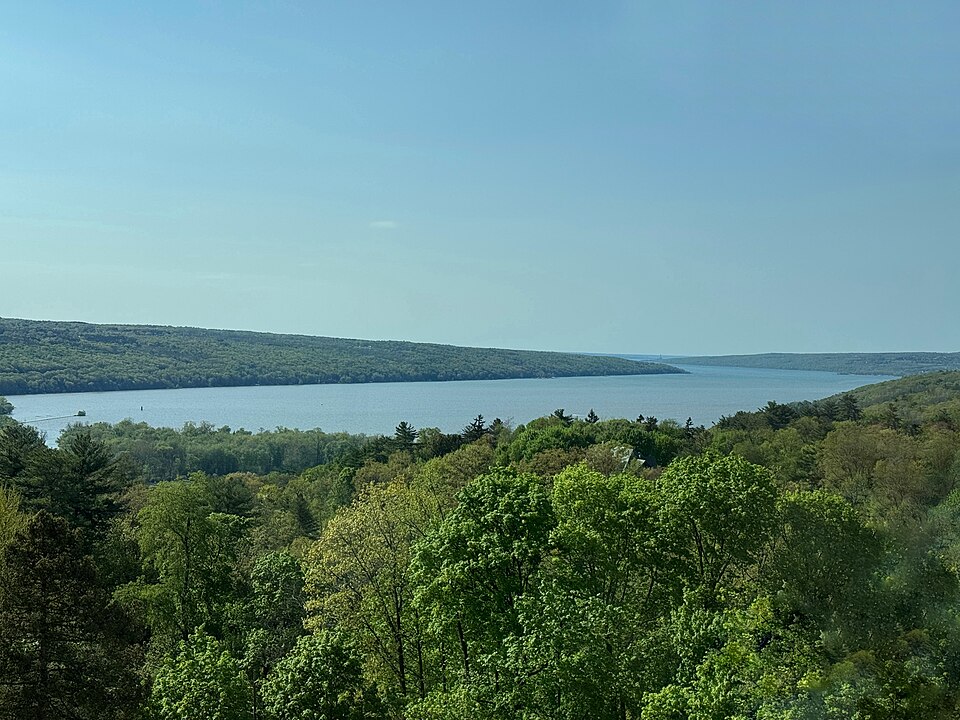
Cayuga Lake, May 2025 Acurarri / Wikimedia Commons — CC BY-SA 4.0
Modern Cayuga Lake regional view. The selected 2014 Cayuga council schoolhouse article explicitly connects language/place discussion with Cayuga Lake; the photograph is not a present government boundary, exact former village or image of all Cayuga communities. Complete available retrieved JPEG imported unchanged. Background/card CSS crops and overlays affect presentation; the opened page retains the complete available frame proportionally.
Image, association, and reuse record reviewed 2026-10-28.
Full photographs are displayed proportionally above. A translucent background copy may be cropped by the viewport; it does not replace the complete image or its record.
The visual treatment does not change the research status, evidence, or remaining gaps recorded in this profile.
Start reading here
A short purposeful path through selected actual-content works. Read annotations for community, period and inspection limits; this is not a complete history or community endorsement.
See a specific Cayuga-stream higher-education pathway rather than treating a language as only a historical subject.
These are selected starting points. The full annotated collection, source perspectives, inspection limits and remaining research questions follow below. A starting guide is not an exhaustive history or community endorsement.
01
Identity and context
Cayuga is one of the Haudenosaunee nations. Different Cayuga communities and governing institutions require distinct treatment.
Focus the next stage of research on: Gayogo̱hó꞉nǫʼ identity, language, homelands and Haudenosaunee relationships. The sources below are selected reading paths; their authorship, dates and community scope should guide how they are used.
A December 2014 council newsletter describes a schoolhouse intended for all-age language and cultural learning. A quoted speaker connects this work with Cayuga Lake and people returning home. The article records the project’s intentions at that time; it does not establish present operation or resolve competing council claims.
Six Nations Polytechnic’s 2016–2017 study investigated adult language learning through community participation, focus groups and questionnaires. Its recommendations connect classroom instruction with speaking in everyday community settings. These selected methods and goals provide a research entry point, rather than a guarantee about how quickly any learner becomes fluent.
Six Nations Polytechnic’s published programme describes separate Cayuga and Mohawk language streams, alongside community, practice and research-methods study. This is one educational institution’s public route into language work, not a description of every Cayuga community or a substitute for community-specific history.
Read stronger independent historical work on Cayuga homelands, displacement and distinct New York, Ontario and Oklahoma contexts.
Resolve identified factual-quality problems in the legacy history page without assuming that one present institution represents all Cayuga people.
The 2014 newsletter’s council perspective and programme plans must remain dated; current operation and competing authority are unassessed.
Cohort12: selected actual-content reviews preserve their institutional/community scope. Existing source cards are upgraded at the same ID and URL where noted; repeated publications are not globally new works.
Follow the reading path
Sources & further reading
Open any title to read the original source. Annotations explain what each link can help you explore.
No Indigenous-led source is identified in this entry yet. This is a gap in this collection, and does not imply an absence of community knowledge or organization.
Retained as an existing link with a factual-quality caution. Identified errors in its cross-nation and legal chronology require independent checking; this page is not used as substantive historical evidence for the new guide.
Inspection: Supporting or limited review; see scope
Scope: Actual public page body inspected, especially cross-nation clan listings and the modern legal chronology, for source-quality assessment only.
Review recorded: October 28, 2026
Access note: Selected public content actually read on 2026-10-28. No access bypass or outreach. Linked collections, media, original manuscripts and additional pages are not automatically inspected or licensed. Normal HTTP200. The page lists eight Oneida clans, conflicting with the Oneida Nation of the Thames account of three, and uses a purported Sherrill Act of 2007. No legal conclusion, recognition decision, present governing authority or claim of compromised-domain control is inferred.
Community or Indigenous-organization perspective linked for this entry. Use “Happy 250th Birthday, America! The Cayuga Nation has shared in your history and congratulates you. – Cayuga Nation” to begin with the publisher’s own account; check whether its scope is one community or a wider people.
The dated community newsletter describes a schoolhouse intended for intergenerational language and cultural learning. Its quoted speakers connect the project with Cayuga Lake and returning home. Read it as this council’s 2014 perspective.
Inspection: Content reviewed for the stated scope
Scope: Actual 12-page PDF: selected complete schoolhouse article on printed/PDF p5, checked in extracted text and a rendered page image. Masthead p1 and surrounding pp1–4 were encountered to establish publication and political perspective.
Review recorded: October 28, 2026
Access note: Selected public content actually read on 2026-10-28. No access bypass or outreach. Linked collections, media, original manuscripts and additional pages are not automatically inspected or licensed. Normal HTTP200. Garbled extracted font text was checked against the actual p5 page image. This is a council-positioned newsletter, not neutral adjudication of competing authority. Political allegations on pp1–2, ceremonies, participant portraits, future completion and current programme operation are not adopted or reproduced.
A community-based 2016–2017 study examines adult language learning, programme coordination and opportunities to use language beyond classes. Its Six Nations focus is a specific community context, not a universal account of every Cayuga or Mohawk community.
Inspection: Content reviewed for the stated scope
Scope: Actual 96-page PDF: title/acknowledgments and abstract, PDF pp1–2 and7; selected background, project goals and study conduct pp8–11; selected focus-group/questionnaire methodology pp28–31.
Review recorded: October 28, 2026
Access note: Selected public content actually read on 2026-10-28. No access bypass or outreach. Linked collections, media, original manuscripts and additional pages are not automatically inspected or licensed. Normal HTTP200 PDF. Full report, appendices, underlying questionnaires and recordings not reviewed. Findings are attributed research recommendations, not independently verified learning-outcome guarantees. Historical participant/speaker figures and ceremonial details are not adopted.
The institution describes a degree with distinct Cayuga and Mohawk language streams and community-oriented study. It provides a concrete route into public higher-education language work at Six Nations.
Inspection: Content reviewed for the stated scope
Scope: Actual programme-description paragraphs, introductory programme-of-study explanation, selected language/grammar, practice, community and research-methods course listings; pathways introduction.
Review recorded: October 28, 2026
Access note: Selected public content actually read on 2026-10-28. No access bypass or outreach. Linked collections, media, original manuscripts and additional pages are not automatically inspected or licensed. Normal HTTP200. Degree requirements are the institution’s published description, not proof of current individual enrollment, course availability or guaranteed proficiency. Fees, admissions eligibility, linked lessons and course content not independently evaluated.
Related entries may represent alternate names, constituent communities, wider groupings, or historical connections. Read the naming notes before treating entries as equivalent.
Robey’s Atlas of Indigenous North America · Compiled October 19, 2026 · Cayuga