Kanien’kehá:ka, commonly called Mohawk, includes multiple communities and governing institutions. This guide uses Akwesasne’s council and museum publications alongside a Six Nations language study as clearly scoped examples, rather than treating one government as representative of all Mohawk people.
See each region’s evidence for historical or present-day scope.
Homeland / region
Northeast / Haudenosaunee
Research depth
Source guide
Source collection
5 annotated resources · 3 Indigenous-led
Inspected sources
3 substantive works · selected content reviewed
Initial adequacy
Still unfinished
Source review
October 28, 2026
A source guide for a deeper dive.This entry provides a brief orientation and an organized reading path. A comprehensive deep dive has not yet been completed. Follow the annotated sources and distinguish primary community accounts from outside reference material.
Still unfinished
A bounded actual-content starting path and specifically scoped credited picture are available. Fuller history, source comparison and community review remain open; quantity does not establish completion.
Assessment recorded October 28, 2026. This is separate from research completion and community review.
Develop separately verified starting paths for individual Mohawk communities and their different governing institutions.
Read community-specific historical and original boundary records before adding detailed chronology or present jurisdiction claims.
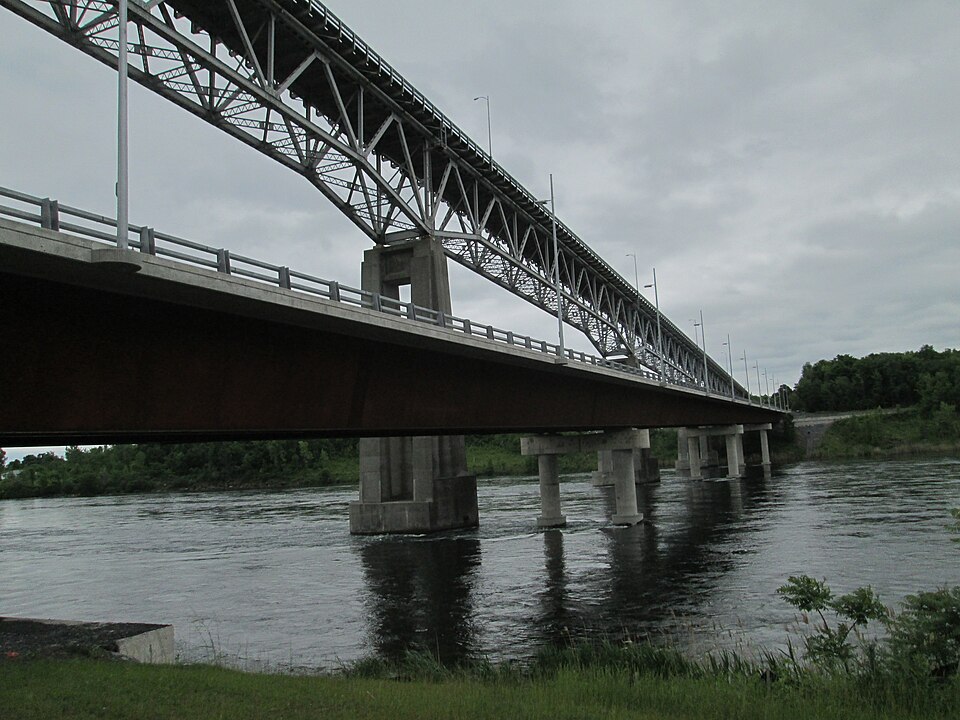
The modern Cornwall–Akwesasne bridge photograph illustrates a named river setting, not all Mohawk people or a territorial boundary.
Backdrop photographs & credits
These photographs have individual, documented connections to this entry. Their captions and source records define the people, place, object, and period shown; no one photograph represents every community within a broader label.
Cornwall–Akwesasne North Channel bridge, 2014 Wikipatr / Wikimedia Commons — CC BY-SA 3.0
Modern Cornwall–Akwesasne bridge in the St. Lawrence River setting described by the Mohawk Council of Akwesasne. This is contemporary regional infrastructure, not Mohawk-made art, one bridge representing all Mohawk people or a territorial/legal boundary. Complete available retrieved JPEG imported unchanged. Background/card CSS crops and overlays affect presentation; the opened page retains the complete available frame proportionally.
Image, association, and reuse record reviewed 2026-10-28.
Full photographs are displayed proportionally above. A translucent background copy may be cropped by the viewport; it does not replace the complete image or its record.
The visual treatment does not change the research status, evidence, or remaining gaps recorded in this profile.
Start reading here
A short purposeful path through selected actual-content works. Read annotations for community, period and inspection limits; this is not a complete history or community endorsement.
Compare a separately situated Six Nations language-research perspective.
These are selected starting points. The full annotated collection, source perspectives, inspection limits and remaining research questions follow below. A starting guide is not an exhaustive history or community endorsement.
01
Identity and context
Mohawk, also described through Kanien’kehá:ka, is one of the Haudenosaunee nations with multiple distinct communities.
Focus the next stage of research on: Community governments, language and cross-border homelands. The sources below are selected reading paths; their authorship, dates and community scope should guide how they are used.
The Mohawk Council of Akwesasne describes a community along the St. Lawrence River divided by the Canada–United States boundary and the Ontario–Quebec boundary. Its account emphasizes continuing kinship across those divisions. The council’s own elected-government description is one institutional perspective within this community.
Akwesasne Museum says its exhibits present Mohawk culture from Akwesasne people’s perspective. Its public account describes arts programmes and youth co-curation of a traveling exhibition. These examples show community participation in interpretation; they do not authorize copying collection objects or imply uniform practices across Mohawk communities.
A Six Nations Polytechnic study conducted in 2016–2017 examined adult language-learning experience and coordination among programmes. Selected methods and project goals offer a second community context for Mohawk language work. Its recommendations remain attributed to that study, without a current speaker census or promised learning outcome.
Develop separately verified starting paths for individual Mohawk communities and their different governing institutions.
Read community-specific historical and original boundary records before adding detailed chronology or present jurisdiction claims.
The modern Cornwall–Akwesasne bridge photograph illustrates a named river setting, not all Mohawk people or a territorial boundary.
Cohort12: selected actual-content reviews preserve their institutional/community scope. Existing source cards are upgraded at the same ID and URL where noted; repeated publications are not globally new works.
Follow the reading path
Sources & further reading
Open any title to read the original source. Annotations explain what each link can help you explore.
No Indigenous-led source is identified in this entry yet. This is a gap in this collection, and does not imply an absence of community knowledge or organization.
Historical context for this entry. Read “Mohawks (Kanien’kehà:ka) | Gouvernement du Québec” with attention to the author, period covered, and communities named; compare with community-published accounts where available.
Context and further reading linked for this entry. The publisher’s “Mohawk (Kanien’kehà:ka) | Gouvernement du Québec” is a starting point; verify the geographical and community scope before applying its account more broadly.
The council introduces its elected community-government role and Akwesasne’s St. Lawrence River setting across international and provincial boundaries. It is a specifically situated Mohawk government account.
Inspection: Content reviewed for the stated scope
Scope: Actual introductory council-role and community/district paragraphs; selected About Akwesasne section identifying the St. Lawrence River, boundary divisions, kinship and other named Mohawk communities.
Review recorded: October 28, 2026
Access note: Selected public content actually read on 2026-10-28. No access bypass or outreach. Linked collections, media, original manuscripts and additional pages are not automatically inspected or licensed. Normal HTTP200. No present officeholder, membership total, legal jurisdiction, pre-contact settlement date or universal Mohawk representation is inferred. Detailed departmental claims and linked history/governance documents were not independently reviewed.
The museum explains how Akwesasne Mohawk people present their own cultural materials, sustain public arts programmes and involve youth in interpretation. It is an institution’s account of community cultural work.
Inspection: Content reviewed for the stated scope
Scope: Actual museum body: opening interpretive/collection paragraphs; traditional-arts programme description; basketry discussion; We Are From Akwesasne youth co-curation paragraph and closing community-planning statement.
Review recorded: October 28, 2026
Access note: Selected public content actually read on 2026-10-28. No access bypass or outreach. Linked collections, media, original manuscripts and additional pages are not automatically inspected or licensed. Normal HTTP200. No collection image, wampum object, workshop instruction or protected material is reproduced. Superlatives, archaeological dating, universal practice and current class availability are not adopted. The museum is not treated as a separate government.
A community-based 2016–2017 study examines adult language learning, programme coordination and opportunities to use language beyond classes. Its Six Nations focus is a specific community context, not a universal account of every Cayuga or Mohawk community.
Inspection: Content reviewed for the stated scope
Scope: Actual 96-page PDF: title/acknowledgments and abstract, PDF pp1–2 and7; selected background, project goals and study conduct pp8–11; selected focus-group/questionnaire methodology pp28–31.
Review recorded: October 28, 2026
Access note: Selected public content actually read on 2026-10-28. No access bypass or outreach. Linked collections, media, original manuscripts and additional pages are not automatically inspected or licensed. Normal HTTP200 PDF. Full report, appendices, underlying questionnaires and recordings not reviewed. Findings are attributed research recommendations, not independently verified learning-outcome guarantees. Historical participant/speaker figures and ceremonial details are not adopted.
Related entries may represent alternate names, constituent communities, wider groupings, or historical connections. Read the naming notes before treating entries as equivalent.
Robey’s Atlas of Indigenous North America · Compiled October 19, 2026 · Mohawk