Tuscarora history includes North Carolina river-region communities and northward movement into Haudenosaunee contexts. This starting path pairs a selected historical reference with a Tuscarora community language project linked by the New York Nation. Present governments, North Carolina community organizations and individual affiliations must remain distinct.
See each region’s evidence for historical or present-day scope.
Homeland / region
Northeast / Haudenosaunee / Carolinas
Research depth
Source guide
Source collection
6 annotated resources · 5 Indigenous-led
Inspected sources
2 substantive works · selected content reviewed
Initial adequacy
Still unfinished
Source review
October 28, 2026
A source guide for a deeper dive.This entry provides a brief orientation and an organized reading path. A comprehensive deep dive has not yet been completed. Follow the annotated sources and distinguish primary community accounts from outside reference material.
Still unfinished
A bounded actual-content starting path and specifically scoped credited picture are available. Fuller history, source comparison and community review remain open; quantity does not establish completion.
Assessment recorded October 28, 2026. This is separate from research completion and community review.
Compare North Carolina and northern Tuscarora histories with original records and separately verified community publications.
Detailed claims in the inherited North Carolina chronology remain unverified and are excluded from substantive counts.
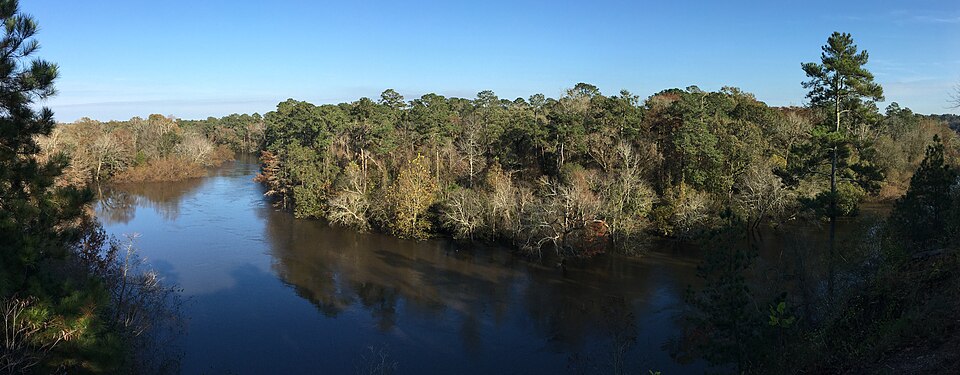
The Neuse River photograph is a modern regional waterway view, not an exact village, present boundary or New York Nation territory.
Backdrop photographs & credits
These photographs have individual, documented connections to this entry. Their captions and source records define the people, place, object, and period shown; no one photograph represents every community within a broader label.
Neuse River at Cliffs of the Neuse State Park, 2020 Fredlyfish4 / Wikimedia Commons — CC BY-SA 4.0
Modern Neuse River regional landscape connected only to the historical reference’s explicit Upper/Lower Tuscarora river-region discussion. Not an exact village location, current community, northern New York Nation land or territorial boundary. Provider describes a photographic panorama; no Atlas-generated landscape or additional assembly. Complete available retrieved JPEG imported unchanged. Background/card CSS crops and overlays affect presentation; the opened page retains the complete available frame proportionally.
Image, association, and reuse record reviewed 2026-10-28.
Full photographs are displayed proportionally above. A translucent background copy may be cropped by the viewport; it does not replace the complete image or its record.
The visual treatment does not change the research status, evidence, or remaining gaps recorded in this profile.
Start reading here
A short purposeful path through selected actual-content works. Read annotations for community, period and inspection limits; this is not a complete history or community endorsement.
Read a community language project’s actual plans and limits rather than assuming outcomes.
These are selected starting points. The full annotated collection, source perspectives, inspection limits and remaining research questions follow below. A starting guide is not an exhaustive history or community endorsement.
01
Identity and context
Tuscarora people have homelands in the Carolinas and later histories within the Haudenosaunee world.
Focus the next stage of research on: Language, migration, distinct communities and Confederacy relationships. The sources below are selected reading paths; their authorship, dates and community scope should guide how they are used.
NCpedia’s edited account places Tuscarora communities along several North Carolina rivers, including the Neuse, and describes colonial encroachment, war and northward movement. This is a historical regional account. It does not assign current affiliation from residence, prove individual descent or turn every North Carolina community into the same present government.
The Tuscarora Language Immersion Project explains plans to develop teachers and materials for adult immersion, adapting resources from a Mohawk programme. Its curriculum is described as revisable. The inspected page seeks funding, so its aims should not be presented as a currently operating full-time class or a proven fluency outcome.
The New York Nation links the language programme, while a separate North Carolina community publishes its own chronology. These are different institutional perspectives. The latter’s detailed historical and descent claims remain further-checking leads; this guide does not use them to adjudicate recognition or merge community identities.
Compare North Carolina and northern Tuscarora histories with original records and separately verified community publications.
Detailed claims in the inherited North Carolina chronology remain unverified and are excluded from substantive counts.
The Neuse River photograph is a modern regional waterway view, not an exact village, present boundary or New York Nation territory.
Cohort12: selected actual-content reviews preserve their institutional/community scope. Existing source cards are upgraded at the same ID and URL where noted; repeated publications are not globally new works.
Follow the reading path
Sources & further reading
Open any title to read the original source. Annotations explain what each link can help you explore.
No Indigenous-led source is identified in this entry yet. This is a gap in this collection, and does not imply an absence of community knowledge or organization.
Indigenous-ledTuscarora Nation of North CarolinaSource 1Supporting reference · outside substantive inspected count
This North Carolina community-published chronology is retained as a perspective requiring independent checking. Selected historical claims and genealogical identifications are not treated as established facts for the new guide.
Inspection: Supporting or limited review; see scope
Scope: Actual long chronology inspected selectively: opening/contact and 1711–1722 entries, later relocation and community-identification passages; source-quality and scope review only.
Review recorded: October 28, 2026
Access note: Selected public content actually read on 2026-10-28. No access bypass or outreach. Linked collections, media, original manuscripts and additional pages are not automatically inspected or licensed. Normal HTTP200. Multiple quotations, legal interpretations, traditional accounts and descent assertions need comparison with original evidence. No present federal/state recognition, common ancestry, identification of other peoples or representation of New York Tuscarora government is inferred.
Retained non-www route to the same titled North Carolina community chronology. It is not an additional historical work or independent corroboration.
Inspection: Supporting or limited review; see scope
Scope: Normal HTTP200 non-www delivery checked against the same titled www chronology and selected body.
Review recorded: October 28, 2026
Access note: Selected public content actually read on 2026-10-28. No access bypass or outreach. Linked collections, media, original manuscripts and additional pages are not automatically inspected or licensed. Same publication and identical delivered length, not claimed as a separate edition or independent account. No second substantive count.
This New York Nation’s contact and programme page links the Tuscarora Language Program. It supplies a narrowly checked institutional bridge, not a full historical work.
Inspection: Supporting or limited review; see scope
Scope: Actual public contact/programme body and explicitly exposed www.tuscaroralanguage.org link inspected.
Review recorded: October 28, 2026
Access note: Selected public content actually read on 2026-10-28. No access bypass or outreach. Linked collections, media, original manuscripts and additional pages are not automatically inspected or licensed. Government contact/navigation is excluded from substantive counts. No current official, enrolment figure, full department record or relation to a different North Carolina organization is inferred.
This edited historical reference describes North Carolina river-region communities, colonial conflict and northward movement. It supplies regional context to read alongside community-led accounts, without defining present Tuscarora affiliation.
Inspection: Content reviewed for the stated scope
Scope: Actual article body: introduction and Upper/Lower Towns river-location paragraphs; selected 1711–1713 conflict and subsequent movement paragraphs. Article originally 2006; revision credited to Government & Heritage Library September 2025.
Review recorded: October 28, 2026
Access note: Selected public content actually read on 2026-10-28. No access bypass or outreach. Linked collections, media, original manuscripts and additional pages are not automatically inspected or licensed. Normal HTTP200. Detailed military/casualty totals, superlatives, proposed affiliations of other peoples and legal conclusions are not adopted. Underlying colonial accounts, maps and cited books were not read. No article or source image is reproduced.
The community programme explains its plan to train instructors and create materials for adult immersion, adapting a Mohawk programme’s methods. It describes intended work and a funding need, rather than demonstrated current outcomes.
Inspection: Content reviewed for the stated scope
Scope: Actual complete short project body: teacher/resource-development goals, adaptation of Onkwawenna Kentyohkwa materials, revisable curriculum and explicit funding-not-students notice.
Review recorded: October 28, 2026
Access note: Selected public content actually read on 2026-10-28. No access bypass or outreach. Linked collections, media, original manuscripts and additional pages are not automatically inspected or licensed. Normal HTTP200 from the exact official-programme link. No curriculum, recordings, original method evaluation, funding status or language-proficiency outcomes inspected. The page’s two-year fluency comparison is not independently evaluated or adopted.
A brief community-programme mission identifies family and everyday-language goals. This supporting introduction is not counted as another substantive work alongside the project page.
Inspection: Supporting or limited review; see scope
Scope: Actual public opening mission/vision paragraphs; logo narrative encountered but excluded from synthesis and visual reuse.
Review recorded: October 28, 2026
Access note: Selected public content actually read on 2026-10-28. No access bypass or outreach. Linked collections, media, original manuscripts and additional pages are not automatically inspected or licensed. Normal HTTP200. No logo or underlying design copied, interpreted or licensed by this reading. No current programme efficacy or speaker totals asserted.
Related entries may represent alternate names, constituent communities, wider groupings, or historical connections. Read the naming notes before treating entries as equivalent.
Robey’s Atlas of Indigenous North America · Compiled October 19, 2026 · Tuscarora