Onondaga is one of the Haudenosaunee peoples. This starting path focuses on the Onondaga Nation’s public New York accounts of contemporary institutions, language and its relationship with Onondaga Lake. It does not equate that institutional perspective with every Onondaga community.
See each region’s evidence for historical or present-day scope.
Homeland / region
Northeast / Haudenosaunee
Research depth
Source guide
Source collection
6 annotated resources · 5 Indigenous-led
Inspected sources
3 substantive works · selected content reviewed
Initial adequacy
Still unfinished
Source review
October 28, 2026
A source guide for a deeper dive.This entry provides a brief orientation and an organized reading path. A comprehensive deep dive has not yet been completed. Follow the annotated sources and distinguish primary community accounts from outside reference material.
Still unfinished
A bounded actual-content starting path and specifically scoped credited picture are available. Fuller history, source comparison and community review remain open; quantity does not establish completion.
Assessment recorded October 28, 2026. This is separate from research completion and community review.
Add separately verified Onondaga community and governmental contexts beyond this New York institutional focus.
Read historical records alongside community accounts without assigning an unsupported founding date.
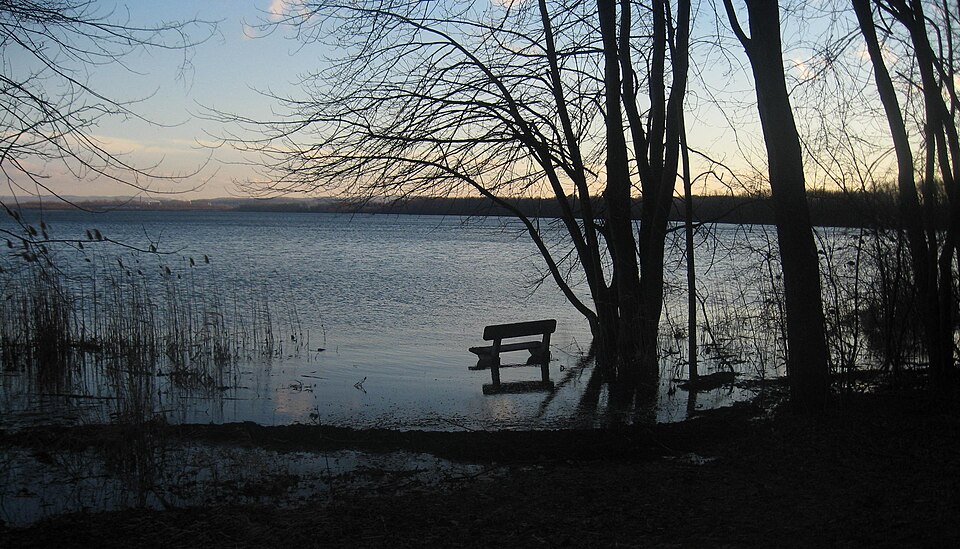
A December 2008 lake view is dated regional imagery, not evidence of present water quality, restoration or boundaries.
Backdrop photographs & credits
These photographs have individual, documented connections to this entry. Their captions and source records define the people, place, object, and period shown; no one photograph represents every community within a broader label.
Onondaga Lake flooded-shore view, December 2008 Hotshotfox / Wikimedia Commons — Public domain — photographer release
Dated Onondaga Lake shore view connected to the Nation’s own lake/watershed vision. The partly submerged bench and water level are conditions visible in December 2008, not evidence of current water quality, restoration completion or a legal boundary. This is the photographer’s worldwide public-domain dedication, not a CC0 or U.S. government claim. Complete available retrieved JPEG imported unchanged. Background/card CSS crops and overlays affect presentation; the opened page retains the complete available frame proportionally.
Image, association, and reuse record reviewed 2026-10-28.
Full photographs are displayed proportionally above. A translucent background copy may be cropped by the viewport; it does not replace the complete image or its record.
The visual treatment does not change the research status, evidence, or remaining gaps recorded in this profile.
Start reading here
A short purposeful path through selected actual-content works. Read annotations for community, period and inspection limits; this is not a complete history or community endorsement.
Distinguish an attributed ecological vision from a current environmental measurement.
These are selected starting points. The full annotated collection, source perspectives, inspection limits and remaining research questions follow below. A starting guide is not an exhaustive history or community endorsement.
01
Identity and context
Onondaga is one of the Haudenosaunee nations, with a central role in the Confederacy’s council traditions.
Focus the next stage of research on: Onondaga-authored history, language, homelands and Confederacy relationships. The sources below are selected reading paths; their authorship, dates and community scope should guide how they are used.
The Nation’s contemporary account emphasizes continuing government, language and cultural life while describing modern homes, work and community facilities. Students can use this account to question historical stereotypes that make Indigenous identity depend on a particular house type or occupation.
The Nation presents language as connected to community interaction and government, and describes Haudenosaunee languages as related but distinct. This guide uses the public explanation without reproducing ceremonial speech or treating one page as a current assessment of speaker numbers.
The Nation’s lake vision treats Onondaga Lake and its watershed as connected to community history and ecological responsibilities. Its desired recovery conditions are aspirations. They should not be read as evidence that present water or fish are safe, that restoration is complete, or that a particular remedy has been achieved.
Add separately verified Onondaga community and governmental contexts beyond this New York institutional focus.
Read historical records alongside community accounts without assigning an unsupported founding date.
A December 2008 lake view is dated regional imagery, not evidence of present water quality, restoration or boundaries.
Cohort12: selected actual-content reviews preserve their institutional/community scope. Existing source cards are upgraded at the same ID and URL where noted; repeated publications are not globally new works.
Follow the reading path
Sources & further reading
Open any title to read the original source. Annotations explain what each link can help you explore.
No Indigenous-led source is identified in this entry yet. This is a gap in this collection, and does not imply an absence of community knowledge or organization.
Community or Indigenous-organization perspective linked for this entry. Use “Timeline – Onondaga Nation” to begin with the publisher’s own account; check whether its scope is one community or a wider people.
Community or Indigenous-organization perspective linked for this entry. Use “History – Onondaga Nation” to begin with the publisher’s own account; check whether its scope is one community or a wider people.
A legacy NYGenWeb historical-reference lead retained for provenance. The current body and publisher authority were not verified in this review. It is excluded from the substantive count and selected reading path; the former Indigenous-led label is withdrawn.
Inspection: Content review not recorded
Access recorded: October 19, 2026
Access note: The earlier normal retrieval failed; no unseen content is treated as read, and no conclusions about the site’s security or authorship are inferred.
Counting note: Inherited historical-reference lead, not established Indigenous-led authority or an actual body inspection.
The Nation explains continuing governance, language and cultural life alongside changing housing, employment and public institutions. It challenges the assumption that contemporary community life must resemble historical depictions.
Inspection: Content reviewed for the stated scope
Scope: Actual ordinary web-reader body: selected opening identity/continuity and contemporary institutions/housing/work paragraphs.
Review recorded: October 28, 2026
Access note: Selected public content actually read on 2026-10-28. No access bypass or outreach. Linked collections, media, original manuscripts and additional pages are not automatically inspected or licensed. Direct normal script requests returned HTTP406; ordinary web reader supplied actual body. No current acreage, individual officeholder, tax/jurisdiction determination, founding date or universal representation is inferred.
The Nation describes language as part of continuing community and governmental life, while distinguishing related Haudenosaunee languages. This is a public explanation, not a language-course assessment.
Inspection: Content reviewed for the stated scope
Scope: Actual public body: selected language-relationship, everyday/public-use and council-title discussion. Ceremonial instructions, songs and opening-address details are excluded from synthesis.
Review recorded: October 28, 2026
Access note: Selected public content actually read on 2026-10-28. No access bypass or outreach. Linked collections, media, original manuscripts and additional pages are not automatically inspected or licensed. Direct script HTTP406; ordinary web-reader/indexed actual body supplied selected paragraphs. No speaker census, current proficiency assessment, lesson recording or restricted material inspected.
The Nation’s vision connects the lake, watershed, plants and animals with community history and responsibilities. It is a statement of aspirations and relationships, not a water-quality finding or completed-restoration report.
Inspection: Content reviewed for the stated scope
Scope: Actual public The People section: lake/watershed relationship, community history and desired ecological recovery. The separate prayer/Creator material is not reproduced.
Review recorded: October 28, 2026
Access note: Selected public content actually read on 2026-10-28. No access bypass or outreach. Linked collections, media, original manuscripts and additional pages are not automatically inspected or licensed. Direct script HTTP406; actual selected ordinary web-reader/indexed body read. No current safety advice, sampling, cleanup outcome, legal remedy or present boundary is asserted.
Related entries may represent alternate names, constituent communities, wider groupings, or historical connections. Read the naming notes before treating entries as equivalent.
Robey’s Atlas of Indigenous North America · Compiled October 19, 2026 · Onondaga