Seneca is a broad people name rather than a synonym for one current government. This path focuses on the Seneca Nation of Indians’ historical account and two of its cultural institutions. Other Seneca community and governmental histories require separately scoped treatment.
See each region’s evidence for historical or present-day scope.
Homeland / region
Northeast / Haudenosaunee
Research depth
Source guide
Source collection
4 annotated resources · 2 Indigenous-led
Inspected sources
3 substantive works · selected content reviewed
Initial adequacy
Still unfinished
Source review
October 28, 2026
A source guide for a deeper dive.This entry provides a brief orientation and an organized reading path. A comprehensive deep dive has not yet been completed. Follow the annotated sources and distinguish primary community accounts from outside reference material.
Still unfinished
A bounded actual-content starting path and specifically scoped credited picture are available. Fuller history, source comparison and community review remain open; quantity does not establish completion.
Assessment recorded October 28, 2026. This is separate from research completion and community review.
Develop separately verified Tonawanda and other Seneca community/government reading paths.
Inspect original historical and archival works alongside these government and institutional introductions.
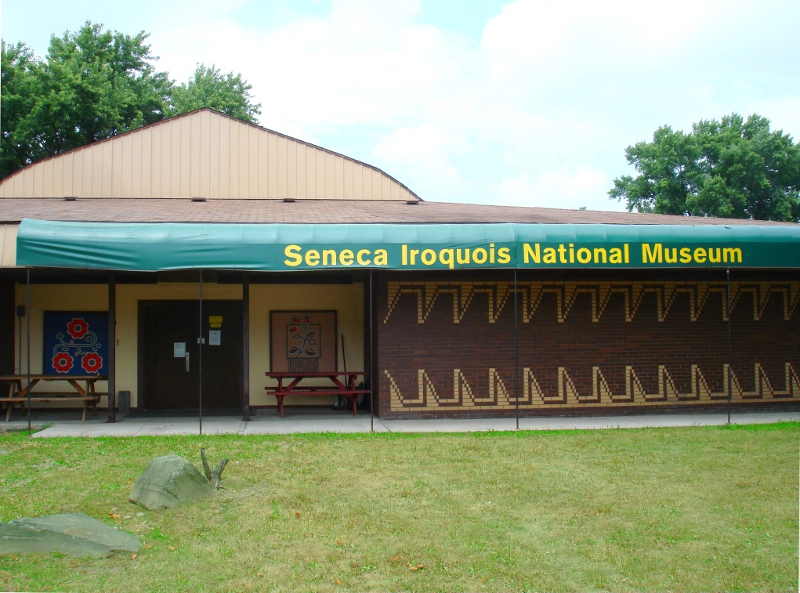
The 2011 museum exterior is a dated whole-building photograph; artwork and collection-object rights are not separately inferred.
Backdrop photographs & credits
These photographs have individual, documented connections to this entry. Their captions and source records define the people, place, object, and period shown; no one photograph represents every community within a broader label.
Former Seneca-Iroquois National Museum façade, 2011 Stilfehler (at Wikivoyage shared) / Wikimedia Commons — CC BY-SA 3.0
Dated whole exterior of the former Seneca-Iroquois National Museum in Salamanca. The museum’s own About account describes a newer cultural-centre home, so this is not labelled the current facility. Small panels and wall decoration remain incidental to the whole-building view; photograph licensing is not a separate clearance, attribution or Atlas reuse of those artworks or collection objects. Complete available retrieved JPEG imported unchanged. Background/card CSS crops and overlays affect presentation; the opened page retains the complete available frame proportionally.
Image, association, and reuse record reviewed 2026-10-28.
Full photographs are displayed proportionally above. A translucent background copy may be cropped by the viewport; it does not replace the complete image or its record.
The visual treatment does not change the research status, evidence, or remaining gaps recorded in this profile.
Start reading here
A short purposeful path through selected actual-content works. Read annotations for community, period and inspection limits; this is not a complete history or community endorsement.
Understand the museum’s interpretive and archival role, including its changed home.
These are selected starting points. The full annotated collection, source perspectives, inspection limits and remaining research questions follow below. A starting guide is not an exhaustive history or community endorsement.
01
Identity and context
Seneca is one of the Haudenosaunee nations, with multiple contemporary communities and institutions.
Focus the next stage of research on: Onöndowa’ga:’ naming, language, homelands and distinct governments. The sources below are selected reading paths; their authorship, dates and community scope should guide how they are used.
The Seneca Nation’s introduction connects Seneca history with the Finger Lakes and Genesee Valley and names its own Allegany, Cattaraugus and Oil Spring contexts. Those named communities should not be treated as a complete account of every Seneca person, government or historical connection.
The Stanley “Sully” Huff Heritage Center describes work linking community learning, language and cultural programmes at Cattaraugus. Its mission emphasizes intergenerational participation. This public institutional account provides a starting route without implying that particular classes or services are currently available to every reader.
The Seneca-Iroquois National Museum describes historical and contemporary interpretation alongside an archival role. Its About page identifies a newer cultural-centre home. The directory photograph shows the older museum façade in 2011; it should not be mistaken for the current facility or permission to reproduce collection artworks.
Develop separately verified Tonawanda and other Seneca community/government reading paths.
Inspect original historical and archival works alongside these government and institutional introductions.
The 2011 museum exterior is a dated whole-building photograph; artwork and collection-object rights are not separately inferred.
Cohort12: selected actual-content reviews preserve their institutional/community scope. Existing source cards are upgraded at the same ID and URL where noted; repeated publications are not globally new works.
Follow the reading path
Sources & further reading
Open any title to read the original source. Annotations explain what each link can help you explore.
No Indigenous-led source is identified in this entry yet. This is a gap in this collection, and does not imply an absence of community knowledge or organization.
The Nation introduces Seneca historical connections to the Finger Lakes and Genesee Valley and names its own territorial communities. It is one government’s account within the wider Seneca people.
Inspection: Content reviewed for the stated scope
Scope: Actual ordinary web-reader/indexed main body: historical regional introduction, naming, selected food/community history and identification of Allegany, Cattaraugus and Oil Spring contexts.
Review recorded: October 28, 2026
Access note: Selected public content actually read on 2026-10-28. No access bypass or outreach. Linked collections, media, original manuscripts and additional pages are not automatically inspected or licensed. Direct script HTTP403; actual selected reader/indexed body inspected. Current membership, employment and enterprise figures, superlatives, racialized warrior descriptions and constitutional-influence claims are not adopted.
The museum home page remains a navigation route. Its linked About page was separately read for substantive institutional context; the landing page is not counted again.
Inspection: Supporting or limited review; see scope
Scope: Public landing-page identity/navigation and link to About checked; no full collection inspection.
Review recorded: October 28, 2026
Access note: Selected public content actually read on 2026-10-28. No access bypass or outreach. Linked collections, media, original manuscripts and additional pages are not automatically inspected or licensed. Direct script HTTP403; ordinary-reader identity/navigation supplied. No object catalogue, photograph collection or archive access is implied.
The Cattaraugus-based centre describes intergenerational language and cultural work, youth programmes and associated community organizations. Its mission is an accessible introduction to one Seneca institution.
Inspection: Content reviewed for the stated scope
Scope: Actual public body under the Heritage Center description and vision/mission: location, language/culture programmes, Seneca Immersion Group, community learning and Native Roots Artists Guild context.
Review recorded: October 28, 2026
Access note: Selected public content actually read on 2026-10-28. No access bypass or outreach. Linked collections, media, original manuscripts and additional pages are not automatically inspected or licensed. Direct script HTTP403; actual ordinary web-reader body read. Current schedules, eligibility, individual staff and programme outcomes are not verified; no lesson, artistic design or cultural instruction reproduced.
The museum explains its purpose of presenting history and contemporary culture and describes a newer cultural-centre home and archival role. It helps distinguish the current institution from the older building pictured in 2011.
Inspection: Content reviewed for the stated scope
Scope: Actual About-page body: museum/archives history and family-records role, new Onöhsagwë:de’ Cultural Center home and stated interpretive mission.
Review recorded: October 28, 2026
Access note: Selected public content actually read on 2026-10-28. No access bypass or outreach. Linked collections, media, original manuscripts and additional pages are not automatically inspected or licensed. Normal ordinary web-reader body. Collection objects, family records, multimedia and restricted research procedures were not inspected or reproduced. No present visitor schedule, archive-access entitlement or independent building chronology is claimed.
Related entries may represent alternate names, constituent communities, wider groupings, or historical connections. Read the naming notes before treating entries as equivalent.
Robey’s Atlas of Indigenous North America · Compiled October 19, 2026 · Seneca